


EXTRACTS FULL TEXT HERE



STUCK INSIDE OF MOBILE: GOING THROUGH ALL THESE THINGS TWICE…
STUCK INSIDE OF MOBILE: …GOING THROUGH ALL THESE THINGS TWICE…
…I wish I was a mole in the ground
Yes, I wish I was a mole in the ground
If I was s a mole in the ground, I’d root that mountain down…
I Wish I Was a Mole in the Ground, Bascar Lamar Lumsford (1928)
…”The more pity that fools may not speak wisely what wise men do foolishly”
Touchstone in As You Like It, William Shakespeare
Stuck Inside of Mobile (With the Memphis Blues Again) is an extended comic fantasia in which Dylan adapts a faux naive persona who repeatedly reminds us that, although he is ‘stuck’ in Mobile Alabama, he really wishes to be in Memphis Tennessee. Like many other Dylan songs of this period, such references are drenched in an awareness of the history of American music.The Memphis Blues, attributed to blues pioneer W.C. Handy, was the first blues song to be published as sheet music and one of the first to be recorded. The city of Memphis is one of the main centres of the blues in the USA.

W.C. HANDY
In the 1920s and 30s its famous Beale Street was the home of key performers like Sleepy John Estes, Memphis Minnie and Furry Lewis. In the 1950s pioneering producer Sam Phillips recorded blues artists like B.B. King, Ike Turner and Howlin’ Wolf in his Memphis based Sun Records studio. Elvis Presley made his first recordings there. Thus the city could thus be called the birth place of rock and roll. This is the ‘blues mother lode’ – a place of security to which the narrator wishes to return.

BEALE STREET
Dylan famously referred to the music on Blonde on Blonde as ‘that wild mercury sound’. Having tried to record several tracks with members of his touring group, later known as The Band, he was dissatisfied with the results. Following the suggestion of his producer Bob Johnston, a ‘good ol’ Southern boy’ himself, he took the surprising step of decamping to Nashville Tennessee, the ‘home’ of country music, accompanied by organist Al Kooper and guitarist Robbie Robertson. The Nashville players, though they were mostly around Dylan’s age, were already highly professional veterans of countless sessions, in which they had to adapt their styles to whatever was required. Yet they had never encountered a musician like Dylan, with his extremely spontaneous approach to recording and his apparently ‘endless’ songs.

Stuck Inside….
On the album each musician is given great freedom to play but their professionalism always prevents them from over-indulging themselves. Their work on Stuck Inside of Mobile epitomises the unique amalgam that was created in the studio. The relaxed ambience of this sound provides the ideal backdrop for a poetic extravaganza which went on to become a mainstay of Dylan’s set lists for many years. Dylan’s drawling, relaxed vocal style and the magical chemistry created by the musicians are the ideal setting for this epic deconstruction of his own psyche.
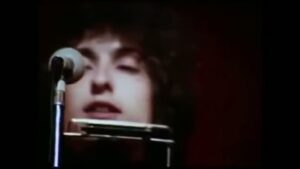
Rather than providing a linear narrative, Dylan freewheels through the nine verses in an apparently random order. Like Desolation Row and Just Like Tom Thumb’s Blues the song creates a world with its own internal rationale, peopled by symbolic ‘cartoon characters’ who make brief entrances and exits. As in It’s Alright Ma (I’m Only Bleeding) (also addressed to an invisible ‘mother figure’) it presents a picture of modern life as stifling, oppressive and highly illogical. But the desperate tension of that song is now replaced by a gleeful comic detachment. Dream, fantasy and hallucination appear to dictate the picture Dylan builds up of a world in which conventional reason is upended or reversed.

The logic of the song recalls that of Luis Bunuel’s surreal satire The Exterminating Angel (1962) in which a group of respectable middle class worthies are inexplicably prevented from leaving an up market dinner party by some invisible force. Similarly, the song’s narrator cannot get away from the ironically named ‘Mobile’ for reasons he never outlines. But the narrator is far from being respectable or middle class. His use of language and attitude clearly establishes him as an anti-establishment figure; a drifter who continually wishes to keep moving on from one experience to another.
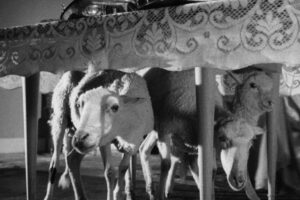
THE EXTERMINATING ANGEL (LUIS BUNUEL)
Leave a Reply