

BOB DYLAN’S POP SONGS OF THE 1980s (Part Two)
EXTRACTS FULL TEXT HERE
Bob Dylan was not the only singer songwriter who struggled in the early to mid 1980s. Artists like Neil Young, Joni Mitchell and Paul Simon all had problems recording albums in this period, especially with regard to current trends in recording techniques. Leonard Cohen even found it difficult to get a secure recording contract. In the wake of the short lived punk and post-punk eras, a new ‘big haired’ pop aesthetic had become dominant. It seemed that the rock and folk rock styles of ten years before were now passé. Forms of ‘70s dance music such as disco were heavily influential on electronic duos such as Eurhythmics and Soft Cell, not to mention on the burgeoning hip hop scene in America. Pop-soul oriented acts like Michael Jackson, Lionel Ritchie, Madonna and Whitney Houston sold vast amounts of albums. Even innovative songwriters like David Bowie (with his pop-funk album Let’s Dance) and Bruce Springsteen (with his pop-rock mega seller Born in the USA) seemed to be buying into current trends. This was also the era of the dominance of the pop video, especially on the American cable TV channel MTV, in which the messages of songs were often reduced to simplistic semi-cinematic dramatisations which were often remembered more by the fans than the songs themselves.
POP SONGS….
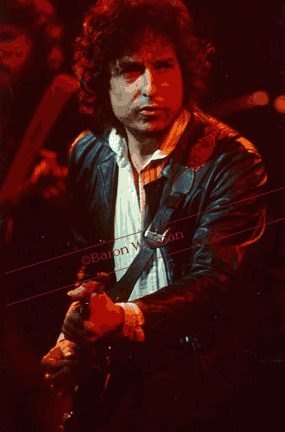
It was in this cultural environment that Bob Dylan attempted to find a new orientation for his music. Despite his enduring fame and influence, he had always been uncomfortable as a ‘celebrity pop star’, rarely giving interviews and never appearing on TV chat shows. The disparity between the scruffy authenticity of his approach to his art and the pop aesthetics of the decade was thrown into particular relief in 1985 when he was drafted in to sing a few lines on Jackson and Ritchie’s excruciatingly sentimental charity song We Are the World. In the shots featuring him in the video of the making of this song he is clearly squirming with embarrassment. Soon afterwards, having been cast as the headliner in the American section of the Live Aid concert, he stumbled on stage with a clearly inebriated and unrehearsed Keith Richards and Ronnie Wood and delivered a ragged performance that seemed entirely out of kilter with the schmaltzy nature of the event.
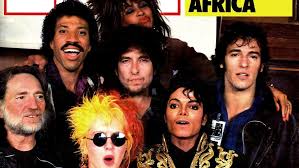
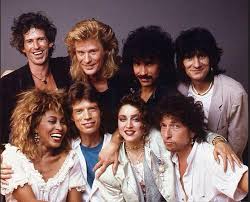
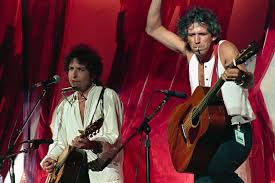
‘WE ARE THE WORLD’ ‘BIG HAIR’ BACKSTAGE AT LIVE AID BOB AND KEEF AT LIVE AID
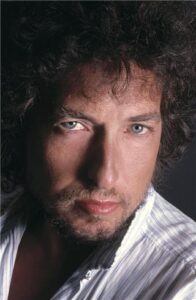
During these years Dylan was actually extremely prolific as a songwriter, but only a handful of his songs (some of which he omitted from his album releases) could be said to replicate the combination of music and symbolist poetry which had made him so original and influential in previous decades. It might be said that in much of his music of these years, he attempted to present himself first and foremost as an entertainer rather than a poet. Despite his ‘intellectual’ status Dylan had in fact always respected the aesthetics of pop music, crediting Buddy Holly as one of his major influences. While many of the other ‘folkies’ sneered at early Beatles music, Dylan had embraced songs like I Want to Hold Your Hand with fervour. A number of his songs became pop hits in the 1960s. During his ‘rural retreat’ of the late 1960s and early ‘70s, he had composed many short country style love songs. By the late ‘70s, Dylan had developed an interest in the mainstream pop music of the day. He was particularly devastated by the death of Elvis Presley in 1977 and his ‘big band’ tour of 1978, with its ‘showbiz’ trappings, was seen by some as a tribute to Elvis’ tragic ‘Vegas period’.
POP SONGS…
Dylan’s desire to experiment with pop styles was also demonstrated by his collaboration with young backing singer Helena Springs on a series of nineteen songs which were intended to help launch her solo career and which generally eschewed lyrical complexity and featured prominent choruses. It is not known which collaborator wrote the lyrics or whether they were co-written. But the experiment cannot be said to have been a great success. None of these songs were officially released by Springs or Dylan, although some were covered by other artists. More Than Flesh and Blood, a version of which was recorded by Danish band Dissing Las and Cross, again relies heavily on repetition of the title phrase but has more developed lyrics, but contains few humorous twists such as …Time regards a pretty face like time regards a fool/ You drive off in your Cadillac and leave me with the mule… and …The meat you cook for me is blood red rare/ It’s more than flesh and blood can bear… Walk Out in the Rain, whose rather generous narrator tells his love to leave him …if it doesn’t feel right… is given an appealing if somewhat inconsequential soft-rock treatment by Eric Clapton, as is I’ll Be There By Morning, with its refrain of …I got a woman living in L.A./ I got a woman waiting for my pay…
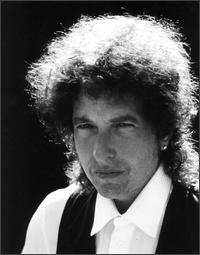
Coming From The Heart and (I Must) Love You Too Much (the second of which was co-written with Greg Lake, vocalist with prog-rock behemoths Emerson, Lake and Palmer) were featured briefly in Dylan’s live 1978 shows. Coming From the Heart, which was played at St. Paul Minnesota on 31/10/1978 could be described as a pop-soul ballad. It boasts an appealing if hardly ground breaking chorus: … ‘Cause the road is long, it’s a long hard climb/I been on that road too long of a time/Yes the road is long, and it winds and winds/ When I think of the love that I left behind… The verses are crammed with clichés such as: …Make me up a bed of roses/ And hang them down from the vine… Later …You will always be my honey…is rhymed with …Our love can’t be bought with money….(I Must) Love You Too Much, which was played at Binghamton New York on 24/8/1978, is a sprightly pop-rock composition with much repetition of the title line. Little of Dylan’s characteristically laconic humour can be found in these songs. But the experiment, despite failing to produce any truly memorable results, appears to have provided him with a template for much of the material he would release in the 1980s. This was reflected by his experiments in covering mainstream rock numbers such as We Just Disagree (written by Jim Krueger for Dave Mason in 1977) and standards such as Fever and It’s All in the Game. In the studio, he even attempted a version of Neil Diamond’s Sweet Caroline.
Leave a Reply