

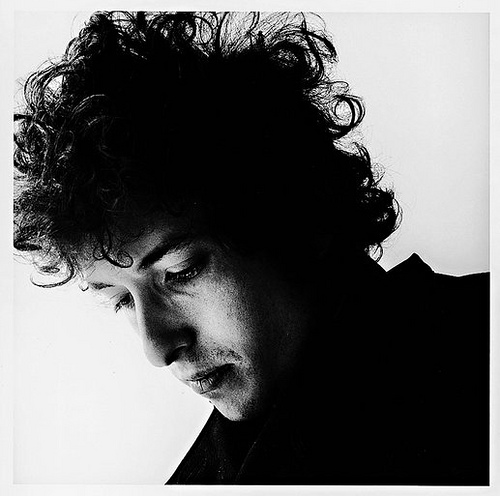
A HARD RAIN’S A-GONNA FALL: BOB DYLAN’S APOCALYPTIC MASTERPIECE
‘A HEADFUL OF IDEAS’ is ranked 3rd in the top 20Bob Dylan podcasts at:
https://www.millionpodcasts.com/bob-dylan-podcasts/
EXTRACTS FULL TEXT HERE
…What immortal hand or eye
Dare frame thy fearful symmetry…
William Blake, The Tyger (1794)
…I read the news today, oh boy…
The Beatles, A Day in the Life (1967)

With the monumental and revelatory A Hard Rain’s a-Gonna Fall Bob Dylan becomes so much more than just a folk singer. In this astonishing seven minute creation, he demonstrates that – as well as having immersed himself in the folk and blues traditions – he has also absorbed much of the English and European literary canon, especially Symbolist, Romantic and Beat poetry, as well as surrealist art. By combining all these influences, he creates a new form of ‘song poetry’ which uses music and dramatic recitation to create an intense emotional response in the listener. Hard Rain is a landmark in modern culture, demonstrating with great eloquence that popular songs can attain the status of high art. It also sets out a marker for Dylan’s career as the most articulate presenter of the pressing concerns of young people in the epochal decade that follows.

HARD RAIN….
Dylan was barely twenty one years old when he wrote the song but he demonstrates an astonishing level of maturity in his approach. Rather than adopting the more literal tone of songs like Masters of War and With God on Our Side, he presents the apocalyptic scenario by means of an exhaustive string of highly visual, often symbolic, images. As Wordsworth, Coleridge and Blake had done, he fashions a unique poetic construction on the foundation of a folk ballad. At the same time he summons up the energy of Beat Poetry through his Whitmanesque use of listings and mesmeric repetition. He delivers the song with great passion, commitment and undeniable sincerity, as if he is squeezing every last drop of meaning he can from every word. The repeated and insistent rhythm of the song is expressed in a guitar figure that sounds more like a blues than a folk backing. The refrain is, once heard, unforgettable. It is not yet a rock and roll song but you can tap your feet to it.

Hard Rain is a highly cathartic song, which is born out of genuine despair and desperation. In the sleeve notes to the Freewheelin’ album Dylan states that it was written at the time of the Cuban Missile Crisis and that every line is potentially the beginning of a new song, as he thought he would not live long enough to write any more. Here, as in many of his other pronouncements, Dylan is certainly using ‘poetic license’. The song was actually completed and performed some weeks before the crisis unfolded, although the threat of nuclear war was already very much present in the months leading up to the standoff between the US and the USSR.
HARD RAIN….
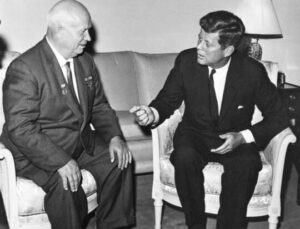
KRUSCHEV AND KENNEDY
In writing it he was confronted with a situation which was far beyond that faced by most of his poetic predecessors. Such was the awesome power of the H Bomb that the nuclear exchange which could have occurred in 1962 would indeed have destroyed human civilisation, if not the entire human race. The only precedents for such a scenario were ancient texts such as the Book of Revelation, which were concerned with nothing less than ‘the end of the world’. Thus Dylan assumed what might be described as a ‘prophetic’ tone, mixed with ineffable sadness and barely restrained anger.

We then hear another surreal alliterative description of …ten thousand talkers whose tongues were all broken… Now the son imagines all the political and religious leaders, philosophical thinkers, warmongers, pacifists, protestors and weapons manufacturers gathered together in one room – ‘talkers’ who can no longer talk – as anything they might say would be, in these circumstances, entirely pointless. This is a spellbinding image of futility, but its dream like quality is immediately brought down to earth by the brutally contrasting …I saw guns and sharp swords in the hands of young children… the ultimate image, perhaps, of the perversion of innocence – one which has tragically been a feature of a number of real wars over the years, recalling the child ‘soldiers’ Hitler sent out to defend Berlin even though defeat was by then inevitable. Dylan’s shift from symbolism to the harshest of realism suddenly raises the emotional level of the song before the refrain comes in.
When we switch from visual to auditory images, it as if the son has been blinded and is now stumbling through the ruins. Or perhaps he is closing his eyes, tormented by his visions. He hears …the sound of a thunder… that … roared out a warnin’…and then …the roar of a wave that could drown the whole world… highly portentous reverberations that make the song’s global dimension quite clear. In another surreal line he hears ….one hundred drummers whose hands were a-blazin’… Drums are often associated with the coming of war. But this is a war like no other. Even the drummers’ hands are on fire. He then hears …ten thousand whisperin’ and nobody listenin’… which is set against …I heard one person starve, I heard many people laughin’… Having moved from the general to the specific, we are then presented with two more individual tragedies. He hears …the song of a poet who died in the gutter… a line which may be a foreshadowing of his own death and …the sound of a clown who cried in the alley… an image which follows on from the hollow laughter of the ‘many people laughin’’.
LINKS…
STILL ON THE ROAD – ALL DYLAN’S GIGS
THE CAMBRIDGE BOB DYLAN SOCIETY
Leave a Reply