

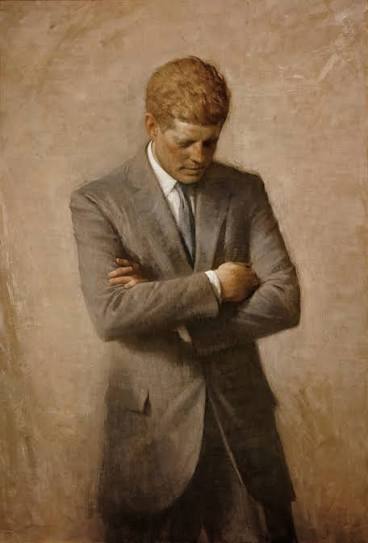
BOB DYLAN’S MURDER MOST FOUL (Part Two)
(Extract from ‘DETERMINED TO STAND’)
This is the second part of my extended exegis of Dylan’s epic ballad MURDER MOST FOUL. Comments welcome below!
This is an extract from DETERMINED TO STAND: THE REINVENTION OF BOB DYLAN
the first part of the PICASSO OF SONG trilogy
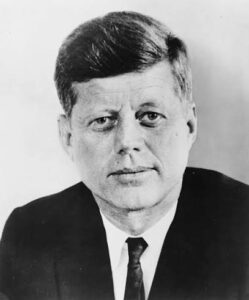
Dylan’s juxtaposition of key symbolic cultural and political moments of the 60s may thus be taken to suggest that the love generation’s faith in the essential goodness of humanity would inevitably be tragically exposed – thus linking the shootings at Altamont to those of the Kennedys. Dylan’s delivery is sadly suggestive here, but the song becomes increasingly ambiguous in terms not only of meaning but of narrative intent. We may ask exactly who the ‘I’ is in these lines. Is it a kind of disembodied ‘dream version’ of Dylan himself (who pointedly did not appear at Woodstock) or is the voice of the ghost of a mythologised ‘heroic’ Kennedy, a ghost which haunts American cultural and political history, hovering over these milestones of the counter culture?
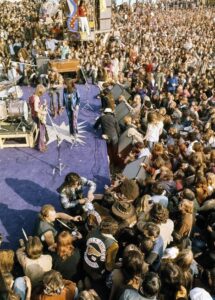
ALTAMONT
Dylan continues to play with such ambiguity as the narrative unfolds, using ironic rhyming to increasingly powerful effect. In the couplet …Put your head out the window, let the good times roll/ There’s a party going on behind the grassy knoll… he refers to Let the Good Times Roll, a much covered rhythm and blues standard first recorded by Louis Jordan in 1946 and There’s a Party Going On (1961), a song by one of his favourite rockabilly singers Wanda Jackson. Both of these energetic rocking numbers implore listeners to forget their troubles and have a good time. The dryly humorous notion of there being ‘a party’ behind the famous grassy knoll – which much evidence points to being the location of the real assassins – again seems to be a sly suggestion that the hedonism of 1960s youth culture masked the real brutality of the political reality of those times.
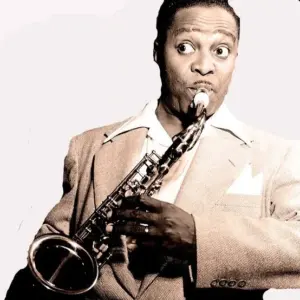
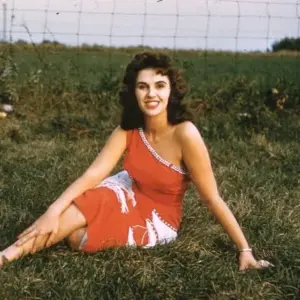
LOUIS JORDAN WANDA JACKSON
MOST FOUL….
As the first part of the second section ‘speeds’ to a conclusion, more real life details of the historic events rack up the tension. The wife of Texas Governor John Connally, who was riding in the car with Kennedy, says …Don’t say Dallas don’t love you, Mr. President… and instructs the driver of the car to …Try to make it to the triple underpass… One of the song’s most devastating lines, with its mixture of deadpan humour and cutting social comment, follows: …Black face singer – white face clown/ Better not show your faces after the sun goes down… so linking the murder to the racism that African-Americans were routinely exposed to, especially in areas of the Deep South where virtual ‘curfews’ were often imposed on their movements. Perhaps the ‘black face singer’ is Sam Cooke and the ‘white face clown’ is Lenny Bruce (who Dylan lionises in one of his songs); both of them tragic victims of brutality and oppression in the 1960s.
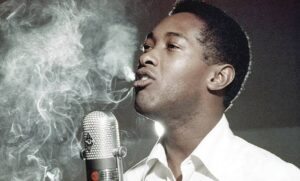
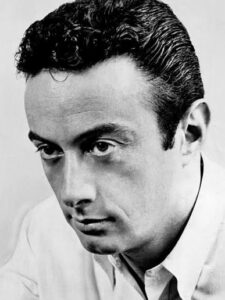
SAM COOKE LENNY BRUCE
The second part of the second section transposes the narrator into the persona of a cop on the beat in Deep Ellum, the poverty stricken red light district of Dallas. Dylan had performed the traditional Deep Ellum Blues – a song which warns the wary visitor to ‘keep your money in your socks’ – in his early years in Greenwich Village. Now he adapts that line in ironic contrast to one of Kennedy’s most famous pieces of rhetoric: …If you’re down in Deep Ellum, put your money in your shoes/ Don’t ask what your country can do for you… teasingly placing an index of the poverty and deprivation experienced by most American urban blacks next to Kennedy’s pronouncement in his inauguration speech: …Ask not what your country can do for you/ Ask what you can do for your country… a statement which celebrates the ideals of American individualism. In this context, however, the notion of Kennedy as a heroic saviour is already being questioned.

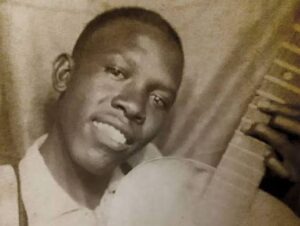
The next line …Cash on the barrel head, money to burn… references two country songs; one by the Louvin Brothers and the other by George Jones. The first song laments the fact that money appears to override justice for poor people in the United States and in the second, a rich man realises that money cannot buy him love. The implied critique of US materialism in the references to these songs is set against more instructions to the driver of the car taking Kennedy to the hospital: …Dealey Plaza, take a left hand turn… The next couplet begins with a verbatim quote from Robert Johnson: …I’m going down to the crossroads, gonna flag a ride… referring to the place where the singer supposedly sold his soul to the Devil, followed by …That’s the place where faith, hope and charity died…. The notion of a ‘crossroads’ already has a double meaning in blues songs – it is the place where the singer meets the Devil, but it is also a place where ‘two roads meet’; where the singer can then choose to follow the path of good or that of evil. Here the ‘crossroads’ may also be part of Kennedy’s driver’s route. The use of the term suggests that Kennedy’s assassination was a ‘crossroads’ in American history.
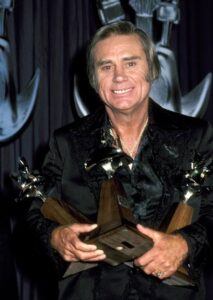
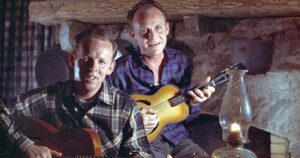
GEORGE JONES LOUVIN BROTHERS ROBERT JOHNSON
MOST FOUL…
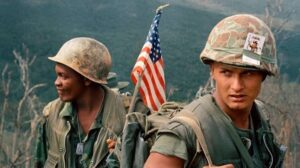
More voices crowd in on us now. That of the ‘criminal mastermind’ behind the killing appears to cry …Shoot ‘em while he runs boy, shoot ‘em while you can/ See if you can shoot the Invisible Man… But are we still in Dallas, or have we leapt forward in time? In the next couplet we are not sure if it is the ‘mastermind’, an arms manufacturer or an American racist who is speaking. But …Goodbye Charlie, goodbye Uncle Sam/ Frankly Miss Scarlet, I don’t give a damn… widens the context of the song further. ‘Charlie’ was the name used by US troops for the Viet Cong soldiers. ‘Goodbye, Uncle Sam’ may refer to the ignominious exit the US finally made from Vietnam in 1973. The second half of the couplet is a paraphrase of the famous words Clark Gable as Rhett Butler says to Vivien Leigh’s Scarlett O’Hara in the ultimate Hollywood Civil War epic Gone With the Wind, a film which, for all its status as a classic movie, romanticises the American Deep South and presents slaves as being passively content with their lot. Dylan’s transposes this familiar phrase – with which Butler famously and tragically rebuts his wayward lover – into a cynical expression of the amorality of those who control a corrupt political and economic system. Thus he both defamiliarises and ‘weaponises’ a very familiar saying and turns it into a powerful expression of disgust. Yet in his delivery of the line, he remains steadfastly, and almost spookily, cool.
US SOLDIERS IN VIETNAM
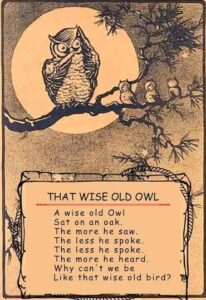
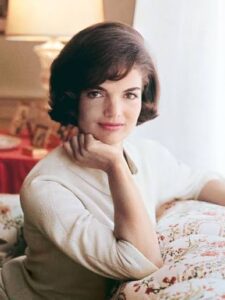
The final couplets of the second section take us back to the Kennedy assassination: …Where is the truth and where did it go?/ Ask Oswald and Ruby, they ought to know… Lee Harvey Oswald, the supposed lone killer of Kennedy, was murdered (live on television) by night club owner and renowned Mafia associate Jack Ruby, just two days after he had been taken into custody. The conspiracy theorists have asserted that Oswald was a CIA stooge and that Ruby – who very dubiously claimed that he killed Oswald to save Jackie Kennedy the pain of having to witness his trial – was ordered to silence Oswald by the Mafia. The final lines answer this with a nod and a knowing wink: …’Shut your mouth’ said the wise old owl/ ‘Business is business, and it’s a murder most foul’… The ‘wise old owl’ is a character from a nursery rhyme:
…A wise old owl lived in an oak
The more he saw the less he spoke
The less he spoke the more he heard.
Why can’t we all be like that wise old bird?…
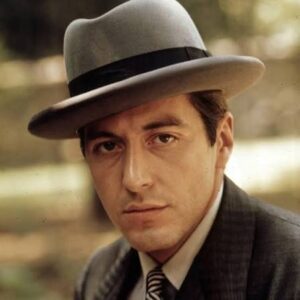
Now the narrator appears to be reporting the words of a Mafia hitman. ‘Business is business’ is a phrase commonly associated with gangsters, who are renowned for ‘putting business first’. This echoes the famous line from The Godfather when Michael Corleone (Al Pacino), explaining to his compatriots his plan to kill a policeman, states that …It’s not personal. It’s strictly business… The gangsters in Coppola’s seminal films are in fact highly patriotic. Their values are quintessentially American – ‘business’, which refers to their form of brutal capitalism, always comes first. The implication is that the American system itself is fundamentally corrupt – that unrestrained capitalism rules everything and that the criminals are as much a part of the American system as the politicians. This system is controlled by brutal violence, with the gun lobby and the arms manufacturers profiting at every stage of the process. In just a few cryptic lines Dylan draws us into this territory, placing the murder of Kennedy in a broad historical context that encompasses modern America, in which these forces still rule.
AL PACINO AS MICHAEL CORLEONE
The third section – which is organised into three ‘subsections’ – continues to provide ever more gruesome details of the assassination, while the song references continue to accumulate. The first subsection again shifts between several different narrators. It begins strikingly with a paraphrase of lines from the Who’s Tommy: …Tommy can you hear me, it’s the Acid Queen… another evocation of the dark side of the hippie dream. The Acid Queen is an evil character who manipulates the ‘deaf, dumb and blind boy’ for her own ends. The hallucinogenic visions that she will provide us with will be dark ones indeed. We immediately switch to the ’ghostly’ voice of Kennedy himself, who is said to be riding in a ‘long black Lincoln limousine’ – the car in which he was shot. The song Long Black Limousine was recorded by Elvis Presley in 1969. The car in that song is part of a funeral cortege for the singer’s friend who was killed in a car crash after a party. Elvis tearfully laments the fact that only now has his friend finally achieved his ambition to ‘ride in a limousine’.
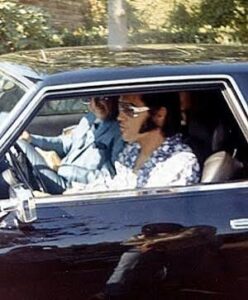
ELVIS’ LIMOUSINE
Elvis’ performance is made especially powerful by its resonance with the then-recent murders of Robert Kennedy and Martin Luther King – and by implication with that of John F. Kennedy.
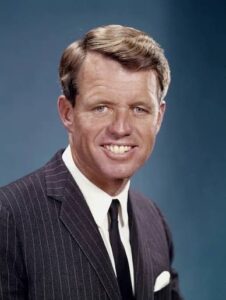
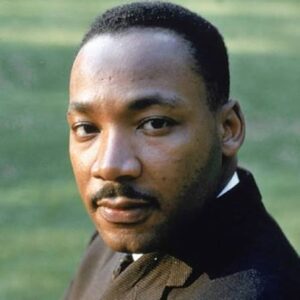
ROBERT KENNEDY MARTIN LUTHER KING
‘Kennedy’s ghost’ then describes how he was riding …straight on into the afterlife… from where he now presumably speaks. Taking us into the ‘present tense’ of the key moments of the shooting, he tells us ...I’m leaning to the left/ got my head in her lap… We then shift abruptly into the voices of the killers: …We ask no quarter, no quarter do we give/ We’re right down the street, from the street where you live… asserting that the members of what is apparently a joint secret service and Mafioso conspiracy are ‘everywhere’, controlling America with violence. The last two couplets of this ‘sub-section’ take us back into the omniscient narrative, supplying graphic but historically accurate details: …They mutilated his body and they took out his brain… Kennedy’s brain was removed and examined by pathologists within days of the assassination. Some conspiracy theorists later asserted that another brain was substituted in order to provide evidence given to the Warren Commission, which ruled that Oswald was the lone killer, and to cover up the fact that Kennedy was shot from several angles
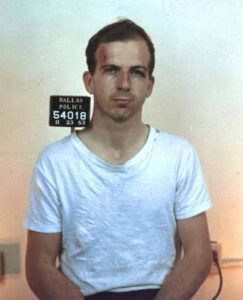
LEE HARVEY OSWALD
…What more could they do? They piled on the pain… Dylan sings ruefully. But then he delivers another devastatingly and darkly funny denouement …But his soul was not there where it was supposed to be at/ For the last fifty years they’ve been searchin’ for that… The rhyme itself is slightly contrived, but this is only adds to the pathos, as if the narrator is slightly incredulous and cannot quite express the gravity of what he is saying. Dylan’s voice drops a little here, as if he is whispering a dread secret. The notion that Kennedy’s soul was a ‘portion’ of his brain that pathologists should have found is a rather bizarre idea. But the symbolism is clear. Kennedy’s ‘lost soul’ represents (as a later line in the song reveals) ‘the soul of the nation’. Murder Most Foul questions what kind of nation America is – the ‘land of the free’ (as patriots love to call it) or a corrupt ‘empire’ which controls both its own people and the rest of the world through violence and racism.
In the next subsection the narratives continue to shift. Sometimes Kennedy seems to be speaking but other voices keep intervening. The first couplet features another ‘deadly’ juxtaposition: …Freedom, oh freedom, over me/ Hate to tell you Mister, but only dead men are free… The first line is taken directly from Oh Freedom! a post Civil War gospel-style song closely associated with the Civil Rights movement, which has been recorded by Harry Belafonte, Joan Baez and many others. ‘Only dead men are free’ is a common epithet which closely resembles a famous line which has been attributed to Plato: …Only the dead have seen the end of war… The President’s ghost then appears to plead for some kind of reversal of time, so that the murder will never happen: …Send me some lovin’, tell me no lie/ Throw the gun in the gutter and walk on by… Two ‘soul classics’ are referred to here – Little Richard’s Send Me Some Lovin’ (1957) and Dionne Warwick’s Walk On By (1963). Both songs are, significantly, cries of hopeless love.
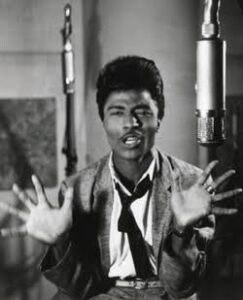
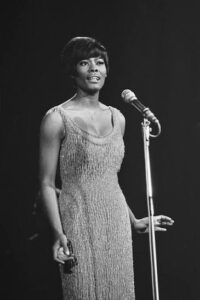
LITTLE RICHARD DIONNE WARWICK
We then get an obvious reference to the Everly Brothers: …Wake up Little Suzie, let’s go for a drive/ Cross the Trinity River, let’s keep hope alive… Wake up Little Suzie (written by Felice and Boudleaux Bryant) tells a tale of teenage lovers who (apparently chastely) fall asleep in each others’ arms all night but then wake up worried about the girl’s reputation. But the reference may also have some autobiographical significance. Suze (pronounced ‘Suzie’) Rotolo was Dylan’s girlfriend in 1963. She appears – in what has become something of a historically iconic image – with a fresh faced young Bob in a snow-covered Greenwich Village street on the cover of his ‘breakthrough’ Freewheelin’ album. A talented artist herself and undoubtedly Dylan’s muse for such songs as Boots of Spanish Leather and Ballad in Plain D, she encouraged him to write the kind of political material that first made him famous. These lines may depict him waking up with her on the morning of Kennedy’s assassination and ‘going for a drive’, hoping that the President would pull through. The Trinity River, however, is near Dallas – although this may be yet another example of shifting perspectives. The next line: …Turn the radio on, don’t touch the dials… may still depict Bob and Suze on their drive. But the following ...Parkland Hospital, only six more miles… seems to take us back, as if in a cinematic ‘dissolve’, into the ‘long black limousine’ carrying Kennedy to the hospital.
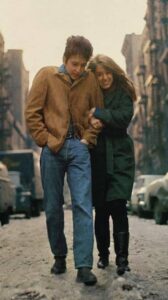
BOB AND SUZE
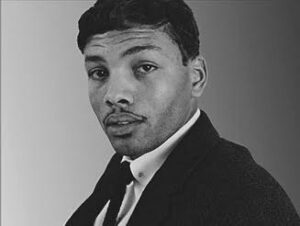
This is followed by some lines which mix more allusions to songs with details of the assassination …You got me dizzy Miss Lizzy, you filled me with lead/ That magic bullet of yours has gone to my head… refers to Dizzy Miss Lizzy, an energetic rock’n’roll stomper recorded by Larry Williams in 1958 and The Beatles in 1965 and You Go to My Head, a romantic standard which was a favourite of Billie Holiday and Frank Sinatra.
LARRY WILLIAMS
The ‘magic bullet’ refers to the official explanation that one of the bullets that killed Kennedy supposedly entered his body, exited it and struck Governor Connally. The fact that this is clearly impossible has been cited as proof that Kennedy could not possibly have been shot by a lone assassin. What follows appears to be the voice of Oswald …I’m just a patsy like Patsy Cline/ Never shot anyone from the front or behind… The renowned country singer Patsy Cline also died in 1963, in a plane crash. The next couplet …Got blood in my eyes, got blood in my ear/ Never gonna make it to the New Frontier… seems to be the voice of the dying Kennedy. Blood in My Eyes – which has an obvious relevance here – is the Mississippi Sheiks song which Dylan covers on World Gone Wrong. The ‘New Frontier’ was a phrase used by Kennedy in his acceptance speech to the Democratic Convention when nominated to run for President in 1960. It came to symbolise the ‘new hope’ he claimed to represent.
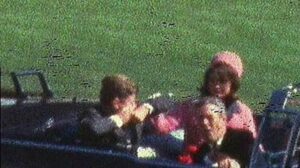
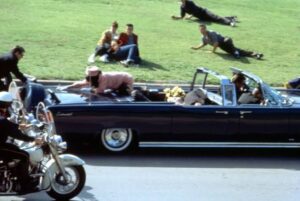
The third subsection begins with an angry and disgusted reaction by the narrator to the viewing of the famous Zapruder film, a home movie shot by a bystander, which the conspiracy theorists claim is further proof that Oswald could not have been the killer. The narrator recoils from the apparent revelation of the truth that the film reveals: …It’s vile and deceitful, it’s cruel and it’s mean… he cries …They killed him once, they killed him twice/ Killed him like a human sacrifice… The narrator, who claims he has watched the film ‘thirty three times or more’, seems to be reeling in shock, having realised what the film (which was not released for public viewing for several years after the assassination) reveals. It may be that this narrator is some ordinary representative of the public, who now knows that he has been lied to. Perhaps it is the ghost of Kennedy again. Or maybe it is the young Dylan himself. It certainly seems to be a young man who then relates the ominous and portentous anecdote …The day they killed him, someone said to me, “Son/ The age of the antichrist has only just begun” …
JACKIE KENNEDY
Dylan immediately switches to a detached present tense commentary, delivered rather like a news report, to which his taciturn delivery lends a rather chilling air of inevitability: ...Air Force One coming through the gate/ Johnson sworn in at two thirty-eight… The historical details are precisely accurate, which makes the chilling warning that preceded them even more prescient, even if the ‘Biblical prophecy’ is not necessarily meant to be taken literally. The narrator appears to be addressing the authors of the endless conspiracy theories when he asks, rather scathingly …Let me know when you decide to throw in the towel… Then the section comes to a curt conclusion, which appears to assert that, whatever conspiracy theory one might believe, the ‘foul’ nature of the murder cannot be denied …It is what it is… Dylan whispers …and it’s murder most foul…
LINKS
STILL ON THE ROAD – ALL DYLAN’S GIGS
Leave a Reply