

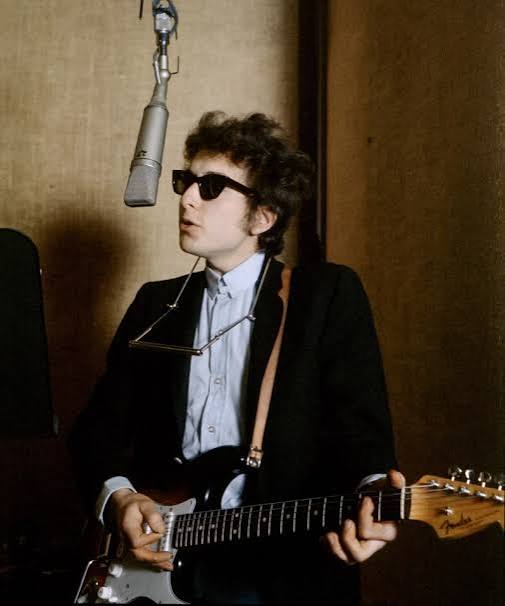
BOB DYLAN AND THE BLUES 1961-66
…Big Bill Broonzy had a song called ‘Key to the Highway’. “I’ve got a key to the highway / I’m booked and I’m bound to go / Gonna leave here runnin’ because walking is most too slow.” I sang that a lot. If you sing that a lot, you just might write: …Georgia Sam he had a bloody nose Welfare Department they wouldn’t give him no clothes He asked poor Howard where can I go Howard said there’s only one place I know/ Sam said tell me quick man I got to run/ Howard just pointed with his gun/ And said “That way down on Highway 61”…
You’d have written that too if you’d sang ‘Key to the Highway’ as much as me…
Bob Dylan, acceptance speech for Musicares Person of the Year Award, February 2015
… songs, to me, were more important than just light entertainment. They were my preceptor and guide into some altered consciousness of reality, some different republic, some liberated republic…
― Bob Dylan, Chronicles, Volume One
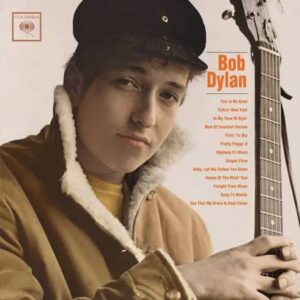
The blues has always been one of the bedrocks of Bob Dylan’s music. It is a musical form which he has constantly returned to throughout his career. On his first album he mainly presents himself as a country blues singer, covering a range of material originating with singers such as Bukka White, Blind Lemon Jefferson, Blind Willie Johnson and Jesse Fuller. Subsequent albums generally feature at least one identifiable twelve bar blues. The influence of this music is absolutely fundamental to Dylan’s aesthetics and how he sees himself as a performer.
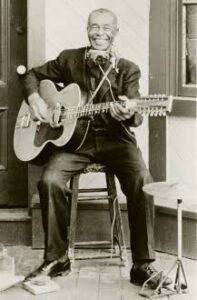
JESSE FULLER
In some of his early interviews he related rather tall tales about meeting various blues legends during his very exaggerated early ‘traveling days’. In the interview with Nat Hentoff which appeared on the sleeve notes of 1963’s Freewheelin’ album he declared that his ambition was to be able to …carry myself like Big Joe Williams… He thus wished to eventually acquire the kind of gravitas that the old blues singers exuded – born largely of a grindingly hard life blighted by the poverty and prejudice that were the lot of the vast majority of black people in the USA during the early decades of the twentieth century.
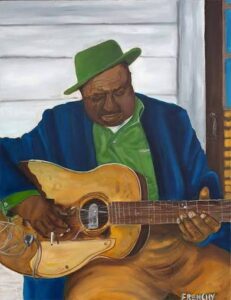
BIG JOE WILLIAMS
Despite the fact that, as his early performances demonstrated, he was deeply steeped in the conventions, lore and musical disciplines of this distinctly American genre of music, the young Dylan was clearly aware that his own personal background – coming from a reasonably comfortable lower middle class home – could never match the depth of lived experience that the great blues singers he so admired had acquired. Yet his devotion to the blues was so intense that he was able to imbue many of the musical and lyrical conventions of the form. He had also never really experienced the ‘hard traveling’ life style personified by his hero Woody Guthrie – itself in many ways an imitation of Guthrie’s blues heroes. But, as Guthrie did, he made it his business to become steeped in the various different forms of the blues.
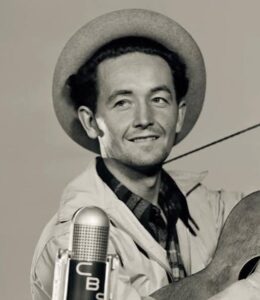
WOODY GUTHRIE
Many of the other white singers he saw and met in Greenwich Village in the early ‘60s – such as Dave Von Ronk and Ramblin’ Jack Elliott – were performing blues material. But they were mainly engaged with their own cover versions of ‘blues classics’, often in a manner that was palatable to white audiences. The precocious Dylan, however, who was barely out of his teens, had listened to blues records so obsessively that he had picked up many of the vocal and musical nuances of the great blues singers. When performing this material, he was never afraid to change and adapt classic blues songs or to deliver the material using an uncompromisingly harsh delivery if necessary. He had an understanding of the poetic nature and emotional character of blues lyrics that was to inform the writing of virtually all of his own songs. The fact that his own life experience was so different to that of the singers whose songs he was performing, combined with his own vast literary intelligence and background, actually gave his own blues material a highly original edge.
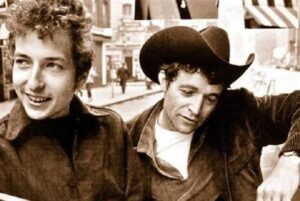
BOB AND RAMBLIN’ JACK
The origins of the blues can be traced back to the call and response work chants of slavery days, which themselves were grounded in West African musical motifs. Such songs – which continued to be sung on the chain gangs and in the prisons into which large numbers of African Americans were being incarcerated throughout the twentieth century – were naturally intended to lift the spirits of those engaged in enforced, back breaking work. They set the pattern for the blues – a form born out of the extreme oppression, poverty and discrimination faced by black people in the early years of the twentieth century.
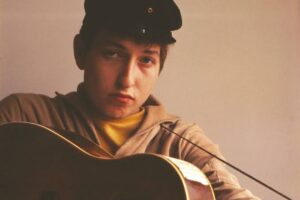
Part of the purpose of the blues, as with the work songs, was to create a kind of ‘secret language’ in which elements of the everyday life of the singers – especially in relation to disappointments in love – became constituted as a subversive way of commenting on their social position. Although the blues dealt with many negative emotions and situations, its purpose was almost always to show that such despair could be reconstituted as a means of survival in a hostile world. The intention of the music was thus transformative – turning hopelessness into a kind of joyful defiance. As Dylan himself explained in the Freewheelin’ sleeve notes:
…What made the real blues singers so great is that they were able to state all the problems they had; but at the same time, they were standing outside of them and could look at them. And in that way, they had them beat…
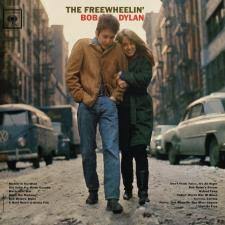
One well known ‘work song’, which Dylan performed a fiery rendition of in his Greenwich Village days, was Po’ Lazarus, which is not – as might be expected – a rendition of the New Testament story in which Jesus returns a dead man to life. Instead it relates the tale of a fugitive who the authorities have gunned down when he refuses to accede to his arrest. It is an unspoken feature of the song that Lazarus, who some of the deputies fear because of his ferocity as a fighter, is a black man and that the law officers are white. Lazarus’ refusal to accept incarceration and his defiance of the white man’s laws represented a kind of stoical rebellion among the inmates. Various versions of the song had existed since the early twentieth century, including one which was a hit in the late 1950s for James Carter and The Prisoners, a vocal harmony group consisting of convicts.
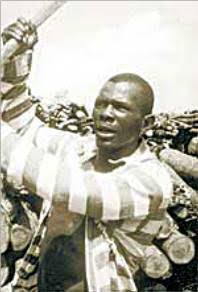
JAMES CARTER
Dylan’s treatment of the song shows his understanding of the ethos of the blues in that he feels free to adapt the text of the song to his own purposes. He extends the narrative to include verses in which the dead man’s family grieve over his loss, turning it into a kind of protest song with similar sentiments to his own contemporaneous The Death of Emmett Till.
DYLAN BLUES
The blues originated in an era before recorded music became widespread. By the 1920s, a section of the music industry became devoted to what was then known as ‘race music’ – songs written and recorded by black singers for a black audience. Over the next two decades this meant that certain performers such as Bessie Smith, Blind Lemon Jefferson and Charley Patton became successful recording artists. But when the Great Depression hit the US in the 1930s this section of the recording industry collapsed.
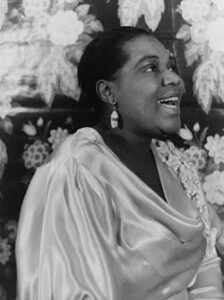
BESSIE SMITH
Many of the performers were forced back into menial work or street busking, and some – such as Son House and Blind Willie McTell – were later rediscovered as much older men by white ‘song collectors’ such as Alan Lomax in the 1950s. Even in the ‘20s and ‘30s, however, the sales of such performers were miniscule compared to those of popular white singers such as Bing Crosby or Al Bowlly. At that time the blues was rarely heard outside of its Deep South origins. But certain, often itinerant, blues performers could make a passable living by providing entertainment for dances. In their performances blues numbers were often mixed with their renditions of mainstream popular songs of the day.
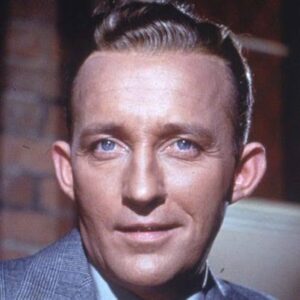
BING CROSBY
The blues material often consisted of what might be called ‘shared texts’. The performers drew on a body of songs, many of which had uncertain authorship. Each singer felt free to adapt these songs to their own vocal and musical styles. What mattered was not ‘authorship’ but the way in which individual performers could inject elements of their own personality into the material, often providing new and surprising twists. The way in which such ‘shared texts’ were performed could also be seen in other ‘folk forms’ in the USA such as Appalachian mountain music and Southern gospel. Even Robert Johnson – who died at only 28 in 1938 and was held up by white blues enthusiasts in the 1960s such as Eric Clapton and the Rolling Stones as the great ‘blues auteur’ – had adapted many of his songs from other singers.
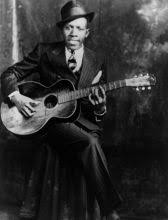
ROBERT JOHNSON
The blues itself is a very basic musical form, with the songs often having very similar melodies. Most blues songs use a fairly rigid twelve bar structure, making it relatively easy for singers to co-opt existing material. One example is Rollin’ and Tumblin’ ; a song associated with the 1950s electric rhythm and blues of Muddy Waters.
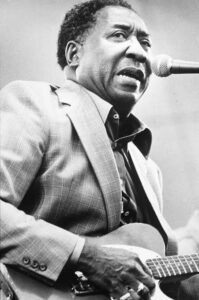
MUDDY WATERS
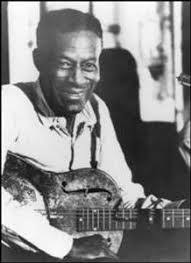
When Dylan recorded his own version of the song (with radically different lyrics) on the 2005 album Modern Times he was criticised in some quarters for supposed ‘plagiarism’. Such accusations ignored the fact that Waters himself had adapted the song from various previous iterations from the 1920s such as that of ‘Hambone’ Willie Newbern. Throughout his career, Dylan has modified much folk and blues material into his own songs. Many of his early songs were based on pre-existing folk melodies. And, like the early blues singers, he would sometimes take snatches of songs and transplant them into new material.
‘HAMBONE’ WILLIE NEWBERN
There is thus a thin line between what can be regarded as ’entirely’ Dylan compositions and those he had reshaped to his own purposes. The Freewheelin’ album includes two songs which illustrate this. His lively, jokey and highly spirited rendition of Honey Just Allow Me One More Chance is credited to the 1920s blues singer Henry Thomas. But Dylan has completely rewritten the lyrics to Thomas’ song, much as he later did with Rollin’ and Tumblin’, retaining only the chorus. Dylan also recorded a quite beautiful version of the traditional song Corrina, Corrine, which he transforms into Corrina, Corrina – cutting out most of the original lyrics and including a verse from Robert Johnson’s version of Stones in My Passway which begins with the wistful…I got a bird that whistles, I got a bird that sings…
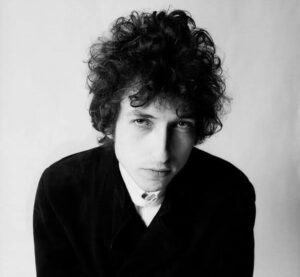
Although these songs are not officially ‘Dylan compositions’, the imposition of layers of authorship is clear. Although such structures appear to be in opposition to conventional notions of authorship, they do imbue the individual songs with considerable depth. It might be said that each new or adapted version of a song ‘contains’ all the previous versions. Even as his ability in composing melodies and lyrics has grown over the years, Dylan has retained this ethos in his song writing. Even highly original and poetic compositions such as Highway 61 Revisited , Pledging My Time or Don’t Think Twice, It’s Alright can all be said to contain ‘echoes’ of previous songs; linking Dylan’s oeuvre to that of the folk and blues traditions and thus making those songs even more resonant.
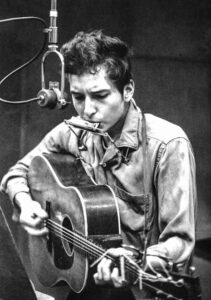
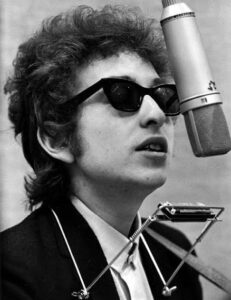
The early blues performers, who had limited opportunities to record, placed great emphasis on developing their songs through live performances. In many cases the singers would need to respond to the requirements of particular audiences. Thus they learned to vary the delivery of each song, often through improvisation. In different performances melodies and vocal inflections would frequently be varied, so that no two performances would be exactly the same. Most singers were not restricted by the perceived need to reproduce a ‘definitive’ version of a song as it had been recorded. This performance ethos was adopted by Dylan at an early stage in his career. It has long been a foundation for his originality and uniqueness as a performer. Throughout his career he has constantly rearranged his songs – often improvising alternate lyrics – to the extent that many ‘punters’ at his shows have been alienated by the fact that they struggle to recognise even his most well known numbers. But there is little doubt that the ‘freewheelin’ ethos of the blues has inspired him to present his songs as ever-evolving.
DYLAN BLUES
By 1962 Dylan’s blues style frequently consisted of speeding up what were originally more lugubrious songs with a kind of manic, frenetic and youthful intensity. Although the blues songs on his first album are credited to their various authors, Dylan brings this style to bear on songs such as Freight Train Blues and Gospel Plow, both of which are delivered at great speed and with considerable vocal dexterity, as Dylan demonstrates just how long he can hold a note. His treatment of the three ‘death songs’ on the album – Fixin’ to Die (associated with Bukka White), In My Time of Dying (famed for Blind Willie Johnson’s version) and Blind Lemon Jefferson’s See That My Grave Is Kept Clean – follow similar patterns, with Dylan adapting many of the lyrics and accelerating the delivery. The album opener, a version of ‘one man band’ Jesse Fuller’s She’s No Good, is heavily rewritten as You’re No Good. It can certainly be said that he makes considerable ‘authorial’ contributions to the songs, presenting himself as a uniquely youthful new voice in the blues tradition.
Among the existing early recordings are records of several outstanding performances by Dylan of existing blues songs. At the Finjan Club in Toronto in July 1962, playing to only a handful of people, he delivers impassioned versions of Muddy Waters’ Two Trains Running (Still a Fool) , the Memphis Jug Band’s Stealin’ and Robert Johnson’s Ramblin’ on My Mind. Earlier in the year, on Cynthia Gooding’s radio show on WBAI New York he performs impeccable versions of Howlin’ Wolf’s Smokestack Lightnin’ and Harry Belafonte’s It Makes a Long Time Man Feel Bad. At Gerde’s Folk City in April he rumbles through Deep Elem Blues, a song warning listeners about a notorious area of Dallas Texas. Judging by the early session lists, the Freewheelin’ album could have turned out to be as much a blues based collection as Dylan’s initial record. However, his renditions of Big Joe Williams’ Baby Please Don’t Go and Robert Johnson’s Wichita Blues and Milk Cow Calf’s Blues show that the rather manic approach of his earlier performances has now been somewhat toned down
Dylan now began to compose his own blues material. An outstanding example of his early blues writing is Quit Your Lowdown Ways (which was recorded for the Freewheelin’ sessions and appears on the first Bootleg Series release), a song for which Dylan supplies a typically energetic vocal, is a kind of amalgam of different blues songs. The chorus line and attendant melody …You’re gonna need my help some day… echoes a song with the same title recorded by Muddy Waters, as well as Bob Wills’ Brain Cloudy Blues and a number of other songs. An entire verse is lifted from Milk Cow Calf’s Blues, although this is closer to Kokomo Arnold’s ‘original’ recording that Robert Johnson’s version. Despite this, the song is listed as a Dylan composition. As he does in the songs on his first album, he ‘attacks’ the lovelorn lyrics with considerable venom. The recording is a tour de force of vocal technique, with Dylan varying his singing between high and low registers, even to the point of yodelling.
The songs he was recording now were mainly his own compositions, although few reached the heights of Quit Your Lowdown Ways. Rocks and Gravel, which was listed as a Dylan composition, was actually a speeded up version of Mance Lipscomb’s song of the same name. In November 1962 the song was one of those included in Dylan’s first sessions with backing musicians (three years before he ‘went electric’), along with a spirited take on Arthur Crudup’s That’s Alright Mama (which had achieved great fame as Elvis Presley’s first hit single) and Dylan’s own rather jokey if undistinguished Mixed Up Confusion, which was released as a single but which sold very few copies. The song does contain a couple of distinctive lines, such as …I’m looking for a woman / Whose head’s mixed up like mine… After outlining various ways in which he is confused, he declares …I’m hung over, hung down, hung up!…injecting a little ‘beat’ language into the song. But here, as in other rather nondescript early efforts like Baby I’m in the Mood for You and Poor Boy Blues Dylan tends to let his enthusiasm for the blues run rampant. Although his performances by now are fairly slick in their execution, these songs tend to recycle blues clichés with little real feeling. With its minimal lyrics, Sally Gal (a rewrite of Woody Guthrie’s Sally Don’t You Grieve) is something of a throwaway and mainly serves as a vehicle for an extended harmonica solo. Standing on the Highway, which recycles some of the Robert Johnson classic Crossroads, is the song of a frustrated hitch hiker who meditates on his life as the cars pass him by. Dylan builds his performance around a hypnotic blues riff.

As Dylan began to gravitate towards more folk-ballad oriented material, most of his newer blues songs were shelved. But one original ‘pure blues’ track which did make it onto the Freewheelin’ album was Down the Highway; a song which demonstrated that his understanding of the medium had advanced considerably since the recording of his first album. It is taken at a sonorous pace. As in most blues songs, the initial lines of each verse are repeated, followed by an offhand comment. The centrality of highways in blues songs reflects the geography of the United States, in which population centres are typically a very long way apart. In many of the most memorable blues, the ‘highway’ functions not only as a physical means of escape for the singer but also as a psychological space which is being explored. In this song there is no mention of which highway this is, or where it is leading to. The opening lines: …I’m walking down the highway/ With my suitcase in my hand… are similar to the opening of another Robert Johnson classic Love in Vain. One of the distinguishing features of Dylan’s song is the way that – as in many great blues numbers – each verse represents a distinct thought or impression. Unlike folk ballads, the poetic method of the blues rarely involves the recounting of a linear narrative. In many ways the order of the verses is interchangeable. What matters is not an unfolding story but the way the singer’s emotions are presented.
The song is also an early example of another blues trope – the switching of narrative perspectives – which will become a common feature of many later Dylan songs. Dylan follows the initial repeated couplet with the simple complaint that …Lord, I really miss my baby/ She’s in some foreign land… But in the second verse he addresses an unnamed ‘you’:…Well, your streets are getting empty/ Your highway’s getting filled… a somewhat contradictory declaration, which appears to suggest that people are fleeing from towns to take to the road. But the identity of ‘you’ remains ambiguous. It seems that Dylan has now come to understand that a blues song does not have to follow a ‘normal’ logical progression of ideas. These lines are followed by the painful claim that …The way I love that woman/ I swear it’s bound to get me killed… He delivers these lines in an almost offhand, dismissive way. Such a transition between rather vaguely poetic observations and sudden emotionalism can be seen in the masterful Love in Vain, in which Johnson, having followed his departing lover to a railway station, similarly juxtaposes relatively straightforward narrative lines such as …When the train come in the station/ I looked her in the eye… with the emotionally wrought …I felt so sad and lonesome/ I could not help but cry…
Dylan tells us he’s been …gambling too long… …I’m bound to get lucky, baby/ Or I’m bound to die tryin’… and that he is …walking down the highway/ Just as far as my poor eyes can see… which are followed by ripostes such as …Right now I’m having trouble/ Please don’t take away my highway shoes… He fantasises about meeting his departed lover …in the middle of the ocean… and wraps up the song neatly by declaring that the highway he is on stretches from…The Golden Gate bridge/ All the way to the Statue of Liberty… In other words, the whole of the USA… Thus we know that this is not a real highway but one in his mind. However, it may be argued that Dylan spoils the effect a little in the penultimate verse, in which the rather neat …The ocean took my baby/ My baby took my heart from me… is followed by the more prosaic … Lord, she took it away to Italy… The song had been, like a number of his early songs, written as a response to his girlfriend Suze Rotolo leaving him to travel to Italy for an extended period of time. The inclusion of this very personal line tends to unbalance the song’s delicate and ambiguous nature.
UNSPECIFIED – CIRCA 1970: Photo of Bob Dylan Photo by Michael Ochs Archives/Getty Images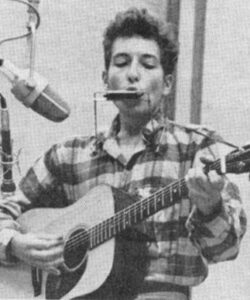
Down the Highway is one of Dylan’s most successful early examples of his understanding of how the poetry of the blues – with its mysterious amalgam of symbolism and emotional reflection – works. Having developed this kind of understanding, Dylan will go on to use the poetic techniques of the blues in many of his songs; even if they are not straight blues numbers. In many ways the way the blues communicates emotion and meaning can be compared to the way the Modern Art of the day gave expression to such qualities, by emphasising the role of the viewer (or listener’s) imagination in ‘filling in the gaps’ in the ‘picture’ being presented. In Love in Vain, with its unforgettable and haunting final lines: …When the train left the station it had two lights on behind/ The blue light was my baby/ The red light was my mind… imagery and emotion are fused in a mysterious way analogous to a painting such as Picasso’s Three Musicians (1921) in which the normal arrangement of the image is broken up and rearranged. The emphasis is now on the way the viewer has to ‘work’ to reconstruct the image in terms of their own logic and notions of spatial assembly.
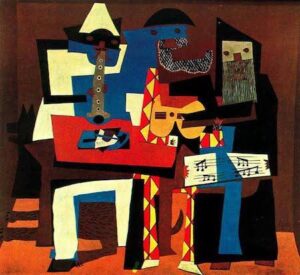
PICASSO THREE MUSICIANS
Similarly, in the greatest blues songs, emotional feelings are not necessarily spelled out but rely on the way the listener makes sense of them. In many of his greatest songs, such as Visions of Johanna and Tangled Up in Blue, Dylan would apply such artistic techniques to produce fractured narratives. And just as a Picasso painting can appear differently to the viewer on different days, so the emotional content of a song can be varied through different performances – one of the defining qualities of the greatest blues songs.
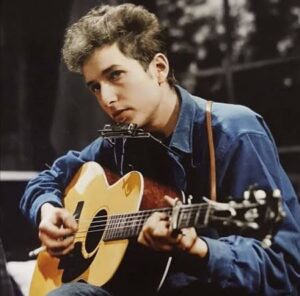
The poetic qualities of the blues are often expressed through metaphors which tend to be shared between singers- both highways and trains figure prominently. Many well known blues songs, such as Leadbelly’s Midnight Special, Junior Parker’s Mystery Train and Elizabeth Cotton’s Freight Train, feature trains as symbolic means of escape. The harmonica player Sonny Terry specialised in imitating trains with his instrument. Dylan recorded Curtis Jones’ 1938 song Highway 51 Blues, in which the road …runs right by my baby’s door… on his first album and also performed the song live on a number of occasions. Highway 51 and Highway 61, both of which run from the Deep South to the Northern Cities, are mentioned in many blues songs. They hold a special significance as they led from an area in which black people were still subject to extreme discrimination and poverty. Both were routes which many black people took in order to find better paid work in the North, especially in the munitions factories during World War Two.#
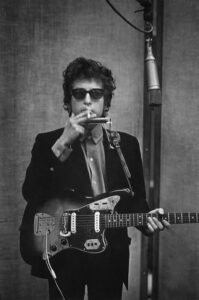
Sexual imagery and double entendres are also common in blues songs, such as Blind Lemon Jefferson’s Black Snake Moan, Big Joe Williams’ Crawling King Snake, Ma Rainey’s See See Rider, Bessie Smith’s Need a Little Sugar in My Bowl and Big Joe Turner’s Shake, Rattle and Roll. The blues is often contrasted with the mainstream pop of the 1920s, 30s and 40s, which tended to present an idealised or adolescent view of sex. Blues songs were more explicit and dealt with relationship problems in a more direct and honest way. Love and sex form the subject matter of the vast majority of blues songs; the majority of which are laments for the singer’s ‘baby’ having deserted him or her. Many blues songs presented an ironical or comic view of sex and relationships or even, as in the case of the standards Cocaine Blues and Candy Man (both of which Dylan played live) a light hearted view of drug taking.

Dylan was particularly enamoured with the work of Jesse Fuller, whose cheery San Francisco Bay Blues he covered in the early 60s and later in 1988. This song epitomises the way in which blues singers often accepted the misery of heartbreak with philosophical grace and a light touch. Although Dylan was never particularly fond of innuendo, in his early days, he also wrote a number of comical ‘talking blues’ and in songs like Don’t Think Twice, It’s All Right, Spanish Harlem Incident and She Belongs to Me he utilised aspects of the blues to present a decidedly adult or philosophical view of love which was heavily influenced by such realistic perspectives.

The blues songs Dylan covered also included songs with a lighter touch, such as the gently melodic Worried Blues, a 1960 song by Puerto Rico-based blues singer Hally Wood and Make Me a Pallet on Your Floor, a favourite of Mississippi John Hurt, who specialised in subtly expressed melodic blues. Their influence can be seen on a very obscure early Dylan song Ballad for a Friend, recorded for a Leeds Music demo in 1962, which relates the sad story of the narrator’s friend who was killed in an accident on a ‘Utah road’, over a generic blues riff. The song has an appealing and distinctive melody. Dylan relates the story impassively, allowing the melody to unfold and letting the lyrics speak for themselves. The understatement recalls the subtle vocal styles work of both Hurt and Lightnin’ Hopkins. Its use of a passive vocal presages later Dylan songs like Shelter From the Storm and Simple Twist of Fate.
DYLAN BLUES
It is important to emphasise that Dylan was hardly the first white singer to be influenced by the blues. Folk performers like Doc Watson, Pete Seeger and Woody Guthrie embraced the form and composed many songs in the idiom. The blues provides the musical structure for jazz, swing, rhythm and blues and later rock and roll, reggae and hip hop. Jimi Hendrix even extended its range into psychedelia, while British rock acts like The Rolling Stones, The Animals, John Mayall’s Bluesbreakers, Cream and Led Zeppelin were all deeply grounded in its ethos. In many ways it also provided the basis for country music (or ‘hillbilly’ as it was previously known). Many country singers covered blues songs or adapted them into their styles. Notable examples included Bob Willis, the ‘King of Western Swing’, Bill Monroe, the ‘father of bluegrass’ and Dylan’s ‘first hero’ Hank Williams who, like Elvis Presley, received much of his musical education from black sources. Williams’ distinctive songs of heartbreak such as Cold Cold Heart and Your Cheatin’ Heart were firmly based on blues models. Dylan recorded his plaintive prison song Lonesome Whistle Blues (a clear forerunner of Johnny Cash’s Folsom Prison Blues) for potential inclusion on Freewheelin’.
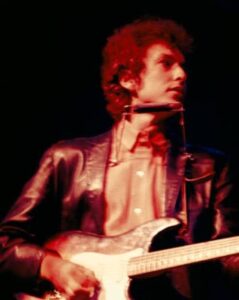
Walkin’ Down the Line is a jaunty early Dylan composition which has been covered by many artists, including Joan Baez, Ricky Nelson, Glen Campbell and Arlo Guthrie (who showcased his version at the 1969 Woodstock Festival). Like the songs of Jesse Fuller, it matches a supposedly depressing lyric describing the state of mind of a person with a deeply ‘troubled mind’ with a light musical surface and some elegant wordplay. The chorus, in which the first line is repeated twice (as in K.C. Moan and See That My Grave is Kept Clean) opens the proceedings and is featured five times, giving the song great potential as an audience ‘sing-along’.
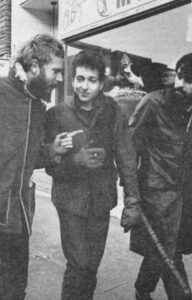
Dylan structures the verses in a similar way. This is followed by the contradictory …My feet’ll be a flying/ Tell you ‘bout my troubled mind… The whole song comes over as a rather cheerful parody of blues songs, with the typical emphasis on the ‘trouble’ that the singer is experiencing. But he never sounds less that cheerful. He tells is that he has a …heavy headed gal… who …ain’t feeling well… then shares with us that …When she’s better only time will tell… It seems pretty clear from this that she is ‘messing him about’, but he appears to accept this with good grace. He cheerfully admits to being a ‘loser’. The next verse contains one of Dylan’s cleverest and funniest lines. After admitting three times that …my money comes and goes… he tells us that …it rolls and flows and rolls and flows through the holes in the pockets of my clothes… cleverly following the statement with a rather delightful triple rhyme, emphasising the fact that he is happy to shrug off his troubles and cheerfully admitting his own hopelessness.
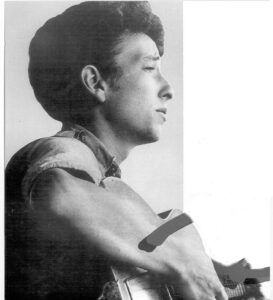
The parody continues as he declares …I see the morning light… as if he has had some profound revelation. But this is immediately brought down to earth by the disclaimer ….It’s not because I’m an early riser/ I just didn’t go to sleep last night… He ends up chewing over blues clichés, as …I’ve got my walkin’ shoes and I ain’t a gonna lose… is followed by …believe I got the walkin’ blues… The song is something of a jovial throwaway, but it reveals that Dylan’s understanding of the form has reached the point where he can confidently lampoon it.
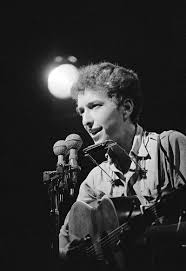
By 1964, as Dylan began to turn away from the ‘folk protest’ ballads that had largely made his name, his interest in the blues was renewed. Black Crow Blues (which he has never performed live) demonstrates how he began to infuse his blues songs with surreal and symbolic imagery. Recorded for the Another Side album, this was the first official track to feature him on piano. His playing is hardly technically advanced but he has a uniquely rhythmic style which suits the material. The verses are interjected with some expansive harmonica solos
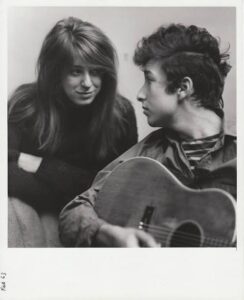
The song‘s sense of comic irony is not so blatant as in Walkin’ Down the Line. Such an approach suits Dylan’s performing style, in which self deprecating irony or barbed humour is frequently present. The song, which has no chorus or discernible refrain, uses the blues convention of the repeated first line in all of its five verses. It even begins with the typical opening ‘woke up this morning’ lines. The narrator, who appears to have a mighty hangover, describes himself as …weary and worn out… The first verse piles on the alliteration of ‘w’ sounds as the narrator tells us that he is …Wishin’ my long lost lover/ Will walk to me, talk to me/ Tell me what it’s all about… This has the effect of making the narrator sound somewhat desperate, but it is hard to sympathise with him as his apparent confusion is seemingly self-inflicted.
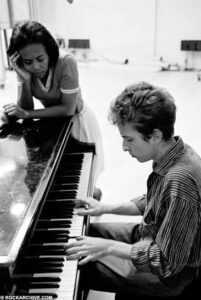
The song skilfully blends typical blues elements with a decidedly insouciant attitude. By the second verse we may begin to suspect that the ‘hangover’ may be induced by a substance more mind-altering than mere liquor. In the repeated opening lines the narrator tells us he is – like Robert Johnson in Crossroads – …standing at the side road… but this is followed by the rather surreal …listenin’ to the billboard knock… Presumably the ‘knocking’ is in his own mind. He also informs us that …my wrist was empty… so he is clearly not likely to ‘catch a ride’ from a passing vehicle.
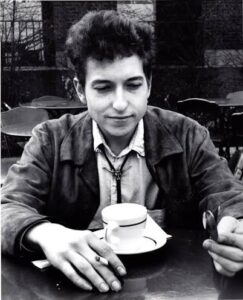
Dylan then employs more semi-parodic lines to convey his ‘wasted’ state of mind and which gel with his ‘stabbing’ piano style: …My nerves were kickin’… he tells us …tickin’ like a clock… As with classic blues songs, emotions are conveyed as much by the music and form of intonation as the lyrics. Each verse is a self contained unit and the order of the verses is basically interchangeable. In the next verse he tries to reassure his ‘long lost lover’ that she can approach him at any time of day for support. Given his state of mind, however, it seems very unlikely that she will do so.
The narrator then becomes a little more explicit about how he is feeling: …Sometimes I’m thinking… he muses …I’m too high to fall… lines which closely resemble those from Rabbit Brown’s James Alley Blues, a song which Dylan performed in the coffee houses: …Sometimes I think that you too sweet to die/ And another time I think you oughta be buried alive … Whether he is ‘high’ on drugs or merely expressing a sense of his own isolation from the woman’s feelings is ambiguous. It is also perhaps unlikely that many members of the audience would, in 1964, actually understand what was still a rather coded ‘drug reference’. In any case the narrator continues to deprecate himself with more marvellously tongue twisting lines: …Other times I’m thinking I’m so low/ I don’’t know/ If I can come up at all… which again positions him as rather lost and confused.
It is the final verse which really distinguishes the song as a highly resonant piece of blues poetry. The repeated line …Black crows in the meadow/ Across the broad highway… is a piece of powerful visual symbolic imagery, suggesting perhaps that the narrator’s path is blocked by these rather menacing birds. Dylan then concludes with the wonderfully tongue in cheek:..Though it’s funny, honey/ I just don’t feel much like a scarecrow today…
The last thing the narrator apparently feels like doing is stirring himself to scare these ‘crows’ away. Indeed he seems quite happy to tolerate their presence. Black Crow Blues marks a crucial stage in Dylan’s use of the blues; demonstrating that he can use the form to construct a kind of dramatic narrative featuring a narrator who may or may not be himself. It is both disparagingly cruel and funny at the same time and it communicates to an audience who can relate to such disarmingly ambiguous attitudes and forms of expression.
In a 2014 interview, Paul Simon mused on the differences between his and Dylan’s styles:
…my voice sounds sincere. I’ve tried to sound ironic. I don’t. I can’t. Dylan, everything he sings has two meanings. He’s telling you the truth and making fun of you at the same time….
In this rueful observation Simon puts his finger on one of the major characteristics of Dylan’s vocal presentation. This sense of dual meaning and ambiguity cannot, however, be said to apply to most of his early protest material such as Only a Pawn in Their Game and With God on Our Side, in which his own views are clearly and unequivocally expressed. But in songs like in All I Really Want to Do and I Don’t Believe You from Another Side, he is now composing songs which are simultaneously self mocking and – as Simon says – have ‘fun’ with audience expectations. These tendencies will be ‘super charged’ in 1965 songs such as Subterranean Homesick Blues, Maggie’s Farm, Tombstone Blues, Highway 61 Revisited and Ballad of a Thin Man; all of which combine ‘serious’ social observation with wry humour. Dylan’s ability to project himself in this way was learned from blues masters like Blind Willie McTell and Lightnin’ Hopkins, whose songs tended to have self-reflective elements. The blues itself has always included strong elements of irony and ‘double meanings’ – constituting a ‘secret language’ which its audience could understand but which often baffled listeners used to more mainstream songs.
Another reason why Dylan could be said to have ‘returned’ to the blues from 1964 onwards was his own desire to escape from the shackles of his own public image as a ‘folk troubadour’, partly by writing more introspective and symbolist lyrics and partly by expanding his own musical template to embrace rock music. In early ’64 The Beatles (whose influences were not especially blues-based) arrived in the US and changed the landscape of rock forever as they achieved unprecedented success. In their wake, many other British groups were successful in America. Dylan was especially impressed by Newcastle-based blues revivalists The Animals, whose stunning rock reinvention of the traditional ‘whore’s lament’The House of the Rising Sun, which they had picked up from Dylan’s first album. When he played his first live ‘electric’ gig at the Newport Folk Festival in 1965 he was backed by members of the Paul Butterfield Blues Band, a white American ‘blues revival’ group whose lead guitarist, Mike Bloomfield, decorated a screamingly loud version of Maggie’s Farm with potent blues riffs.
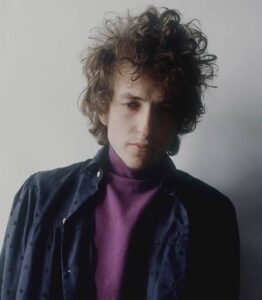
As well as being the basis of the new rock music, the blues was also a form which was revered by the anti-establishment youth movement of the 1960s because it had always been the music of cultural resistance to the dominant norms and values of society; as well as being far more sexually explicit and emotionally honest than the mainstream pop music of the pre-rock era. The blues was a cultural expression of alienation from those norms and values, and – especially after the Cuban Missile Crisis, the US involvement in Vietnam and the introduction of extremely punitive drug laws – many young people now felt similarly alienated. Dylan became the most prominent and articulate voice in expressing such sentiments, for which the language and the manner of the blues provided him with much ammunition.
In Outlaw Blues and From a Buick 6, songs from 1965 in which he is backed by a full electric band, Dylan finds a new freedom in his exploration of the blues, delighting in taunting his audience with what sometimes seem like randomly comic narratives. He twists the language into strange new shapes as he delivers various wryly humorous observations. Each of the verses in Outlaw Blues could stand alone and their order could easily be rearranged. This is a kind of ‘nonsense song’ which anticipates some of Dylan’s work on The Basement Tapes. After complaining that he has stumbled into a ‘muddy lagoon’ he references Sonny Boy Williamson’s Nine Below Zero, a song in which the narrator’s girl throws him out of her house into extremely low temperatures. No context is supplied, as in the next verse where, for some reason, he refuses to hang a picture on the wall. Then he declares …I might look like Robert Ford/ But I feel just like Jesse James… referring here to perhaps the most well known Western outlaw and his famously cowardly killer and identifying himself as both outlaw and victim.
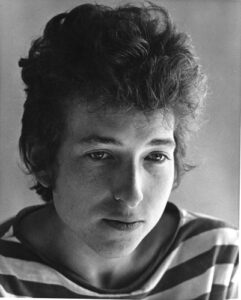
He then expresses the wish, for no apparent reason, to be on …some Australian mountain range… He informs us he is wearing dark sunglasses and that he is …carryin’ for good luck my black tooth… lines adapted from California, one of his earlier attempts at a blues song, then follows this with a very Dylanesque double negative: …Don’t ask me nothin’ bout nothin’… he sings, enigmatically …I might just tell you the truth… Finally we hear that he has a ‘brown skin woman’ in Jackson, which perhaps seems like an unnecessary addition. If the song has a theme at all it may be that Dylan is both mocking and celebrating his own status as an ‘outlaw hero’ – while challenging listeners to make sense of these apparently random pronouncements.
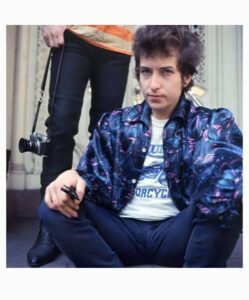
Sitting on a Barbed Wire Fence, which Dylan made several attempts to record in the early Highway 61 sessions, is another ‘nonsense’ song full of random and possibly improvised lyrics. We hear that the singer’s bulldog has bitten a rabbit, while his…hound dog’s sittin’ on a barbed wire fence… He jokes that …This woman I’ve got, she’s killing me alive… and protests that …She’s making me into an old man, And man I’m not even twenty five… An ‘Arabian doctor’ appears, treats him, but refuses to reveal what his illness is. Although it is a throwaway (mainly a vehicle for Mike Bloomfield’s incendiary guitar solos, which do much to enhance the sound of the album) Dylan clearly now has the confidence to use the blues for slyly comic effect.
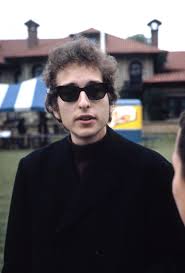
From a Buick 6 is a more coherent piece but here Dylan again delights in throwing out bizarre and apparently unrelated images. It is one of a number of Dylan songs from this period in which the title seems to have little relation to the lyrical content. The first three lines of each verse are countered by the refrain … Well if I go down dyin’. You know she bound to put a blanket on my bed… The song, which is now accompanied by a full electric line up with Mike Bloomfield on guitar, takes the premise of Black Crow Blues and Outlaw Blues even further. The self-mockery here is, however, even more extreme. The narrator depicts himself as fully dependent on his woman, without whom he appears to be helpless. And here the sense of being in an ‘altered state’ seems to permeate the entire song. The first verse is devoted to three descriptions of his lover, who is a ‘graveyard woman’, a ‘soulful mama’ and a ‘junkyard angel’. It appears that the narrator is no longer just ‘getting high’ but is now in a state of dependency. On one level, amid the imagery of ‘junk’ and ‘graves’, the ‘woman’ may represent a dangerous and addictive substance that he appears to need to keep him going. As the song progresses he begins to sound more and more desperate. He mixes up external and internal descriptions in the harrowing lines: … When the pipeline gets broken and I’m lost on the river bridge/ I’m all cracked up on the highway and down by the water’s edge… Here the imagery of ‘pipe lines’ and being ‘cracked up’ seems to suggest a very perilous dependency, despite the woman coming …to sew me up with thread…
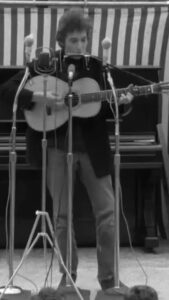
Despite its dark intimations, however, Buick 6 is still a humorous song, especially when Dylan describes the woman as a gun-toting saviour who …keeps this four-ten all loaded with lead… and, in the song’s funniest line: …She walks like Bo Diddley and she don’t need no crutch… he compares her, rather bizarrely, to the seminal blues/rock singer. Finally he delivers the unforgettable ‘loser’s couplet’: …I need a steam shovel mama to keep away the dead/ I need a dump truck, baby, to unload my head… The strangely ‘industrial’ images of ‘steam shovels’ and ‘dump trucks’ convey the feeling that the protagonist is so ‘wasted’ that he is desperate for assistance. Yet the lines, containing the ultra-hip phrase ‘unload my head’ are also extremely funny, with Dylan connecting the image of a person whose mind is so ‘overcrowded’ with pressure and information that he feels he has to ‘unload’ all his problems. Here he burrows into the mind set of disaffected youth with a twisted smile while simultaneously conveying feelings of extreme fear and ecstatic exhilaration.
Perhaps Dylan’s most effective use of the blues for comic effect in this period is 1966’s Leopard Skin Pillbox Hat, in which he develops his characteristic word play to achieve quite spectacular effects. The song recycles a few phrases from Lightnin’ Hopkins’ Automobile Blues, whose narrator mocks a rich socialite girl (who could, perhaps, also be identified as the subject of Like a Rolling Stone) who seems too easily impressed by her new lover with his ‘flash car’. But Dylan extends this conceit considerably, teasing her mercilessly. The music here is full on grinding Chicago blues, with both Dylan and Robbie Robertson supplying piercing guitar solos – clearly inspired by Muddy Waters’ characteristically boastful but subtly self mocking songs like Hoochie Coochie Man and Mannish Boy. Dylan only uses the repeated first line in the first verse and uses …brand new leopard skin pillbox hat… as the repeated refrain. But here he utilises the blues convention of opening lines being followed by offhand comments in a gloriously comic way. …Well you must tell me baby… he sings …How your head feels under something like that… Throughout the song, the ill fitting hat itself – as a symbol of the ludicrousness of fashion and pretentiousness – is focused on, with Dylan playing the faux-naïve narrator.
The second verse is the most justly celebrated part of the song, with Dylan taking advantage of the blues convention of extending lines to brilliant comic effect. He begins by flattering her …You look so pretty in it… he coos. But then he subverts the conventional romantic approach by asking …Honey, can I jump on it sometime?/ I just wanna see/ If it’s really the expensive kind… sly suggesting that the hat may in fact be a cheap imitation. This is followed by the tour de force of comic expressionism …You know it balances on your head just like a mattress balances on a bottle of wine… We get the impression that the girl will actually be impressed by this rather wonderful example of mock-flattery. The following verse winds this back a little as he offers to take her top some undisclosed location to ‘watch the sun rise’. But he immediately subverts this by describing the scene in absurd terms: …Me with my belt wrapped around my head and you just sittin’ there/ In your brand new leopard skin pillbox hat…
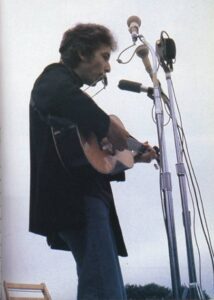
The final verses focus on the girl’s infidelity, with Dylan delivering more razor sharp lines. First the narrator is told by his doctor, rather absurdly, that going to see her would be ‘bad for his health’. He ignores this, then discovers that she is with the doctor. His response is to deadpan: …I don’t mind him cheatin’ on me/ But I sure wish he’s take that off his head… Then he attempts to ‘spy’ on her again and discovers she has ‘a new boyfriend’. We then get two unexpected comic twists; firstly …Well I saw him making love to you/ You forgot to close the garage door… suggesting that in reality she is an exhibitionist who displays her lovers like ‘prizes’. Then, in another brilliant reversal of conventional platitudes he exclaims …You might think he loves you for your money/ But I know what he really loves you for… The joke here is that this ‘material girl’ actually expects to be loved not for her beauty or personality but for her wealth. In each verse the refrain makes her seem more and more ridiculous and superficial. Some commentators have identified the subject of the song as Edie Sedgwick, one of Andy Warhol’s supposed ‘superstars’, who Dylan is rumoured to have had some romantic involvement at this time. However the song works best as a general mockery of the superficiality of fame and fashion – a spiral that Dylan himself was caught up in and from which he would soon beat a hasty retreat.
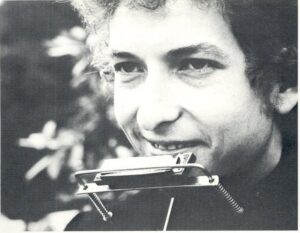
Another, rather more serious, song Dylan wrote at this time but only performed once ion concert was Long Distance Operator. The song eventually found its way onto the official release of The Basement Tapes in 1975, in a rendition by The Band. This is a fairly low key blues number, using repeated first lines and a standard blues progression, in which the narrator appears to be frustrated about not being able to reach his lover on the telephone. There is a distant echo here of Chuck Berry’s heartbreaking Memphis Tennessee; which has a similar premise. But this song takes a surreal turn as Dylan declares that the …phone booth’s on fire… and that there are …thousands in the phone booth… The song appears to be a rather offhand commentary on the pressures of fame as Dylan sings …Everybody wants to be my friend/ But nobody wants to get higher… and then concludes with … Long distance operator/ I believe I’m strangling’ in this telephone wire…
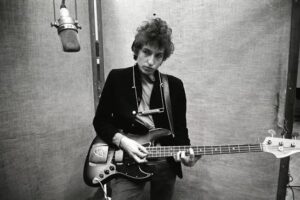
The highly rhythmic Obviously Five Believers, which resembles the fast, cheeky blues style popularised by The Rolling Stones, with harmonica interjections by Charlie McCoy, is another song in which Dylan appears to be suffering from too much unwanted attention. It takes the form of an address to a girl who seems confused by the narrator’s approaches. His entreaties are, however, hardly seductive as he twice tells her: …I guess I could make it without you/ If I just didn’t feel so all alone… Using a typical blues metaphor he recounts that there is a …black dog barking… outside my yard… But he seems too tired to actually outline the meaning of this symbol to her: …I could tell you what he means. If I just didn’t have to try so hard… which may reflect Dylan’s own exasperation at having to continually ‘explain’ his songs to an audience who continually present him with dubious interpretations. The girl’s ‘mama’ seems bewildered by the appearance of: …Fifteen jugglers/ Five believers/ All dressed like men… He tries to reassure ‘mama’ that …They’re just my friends… a lightly comic touch but one which appears to refer to the entourage of ‘freaks’ and hangers on that are now surrounding him.
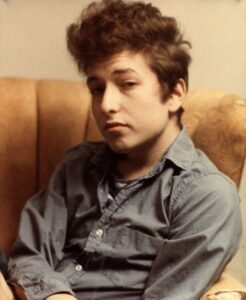
Because he has absorbed many different styles of the blues, by 1966 he is able to produce blues songs that express a wide range of emotions. Pledging My Time is a slow blues which is addressed to his ‘baby’, although no actual details of the relationship are given. In many ways, like Obviously Five Believers, the song expresses his personal feelings of being ‘hemmed in’ by the expectations of his audience. The song has a distinct air of claustrophobia. Unlike Dylan’s comic-ironic blues songs, here he genuinely ‘has the blues’. As with songs like It Ain’t Me, Babe and All I Really Want to Do… the address to a woman may double as a message to his audience. The narrator is in genuine pain. He tells us that …I’ve got a poison headache/ But I feel all right… But this is mere bravado. He complains that his ‘baby’ has been stolen by a ‘hobo’: …He stole my baby/ Then he wanted to steal me… Perhaps the ’hobo’ is actually the early, scruffily attired figure of the ‘acoustic Dylan’ with his Woody Guthrie-like pretentions; an image he has clearly grown weary of.
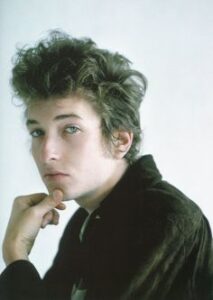
The narrator appeals to his ‘baby’ to stay with him but then he gives us a poignant expression of how trapped he actually feels: …Well, the room is so stuffy/ I can hardly breathe/ Everybody’s gone but me and you/ And I can’t be the last to leave… The final verse is, however, the most haunting of all, featuring some sharp and ironic word play: …Well they sent for the ambulance/ And one was sent/ Somebody got lucky/ But it was an accident… Although blues songs generally try to overcome feelings of depression, this song is perhaps an exception as it appears to express a genuine fear of the future, as if Dylan has been backed into a corner and is worried that there may be no way out. The smooth, reassuring surface of the music tends to disguise such emotions, which makes these final lines more subtly disturbing.
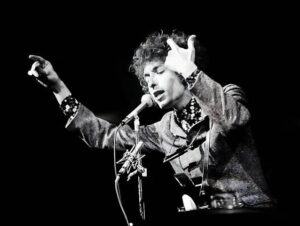
The song which perhaps most expresses and encapsulates Dylan’s love for and understanding of the blues is 1965’s It Takes a Lot to Laugh, It Takes a Train To Cry, a song which is steeped in blues tradition. Most of the third verse is adapted from Leroy Carr’s Alabama Woman Blues, by way of Dylan’s own Rocks and Gravel. In its original form, as Phantom Engineer, it was a much faster paced song. The version played at Newport Folk Festival in 1965, during Dylan’s famously controversial first electric performance, is delivered with a manic intensity as Mike Bloomfield lets rip with stinging guitar solos. After various try outs in the studio in this style a slower, more understated approach to the song was adopted. This proved to be a masterstroke. In the final take, Dylan sounds highly relaxed, holding the stretched notes confidently and supply restrained harmonica interludes. Drummer Bobby Gregg and bassist Harvey Brooks supply a languid ‘slap rhythm’, which is offset by Paul Griffin playing a delicate counter melody on piano. Bloomfield is now highly restrained, supplying decorative licks rather than dominating the sound. All of this creates a suitable atmosphere for a song which is crammed with sexual innuendo. It can be argued, in fact, that the entire song is one long, passionate but carefully measured, sexual entreaty.
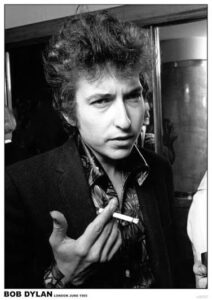
Sexual symbolism has been a frequent element of the blues since its earliest days. Blues singers, from Bessie Smith’s Need a Little Sugar in My Bowl (1931) to Muddy Waters’ I’m A Man (1955), could be very explicit in their declarations, Trains are frequently used as sexual symbols. There is little doubt what kind of engine Elvis Presley is riding on his incandescent version of Junior Parker’s ominous Mystery Train. But the sexuality Dylan conveys here is far more self assured, as he uses the metaphor of a train ride to simulate a relaxed, patient coupling rather than a lust filled rush, as Presley’s song implies …I ride on a mail train baby… Dylan begins, over the soft shuffle of the backing music. …Can’t buy a thrill… The latter phrase, which was famously adopted by Steely Dan as the title of their groundbreaking first album, seems to imply that the loving acts that will now unfold are simple pleasures that we can all share, regardless of wealth. …I’ve been up all night… Dylan continues …Leaning on the window sill… Then he declares …If I die on the top of the hill/ And if I don’t make it, You know my baby will… He stretches out the word …hill… simulating both the uphill train journey and growing sexual passion. It seems that the ‘death’ he is anticipating is in fact what the French call the ‘little death’ of orgasm. But this no macho boast. He seems more concerned that his ‘baby’ will make it ‘to the top of the hill’ than he himself.
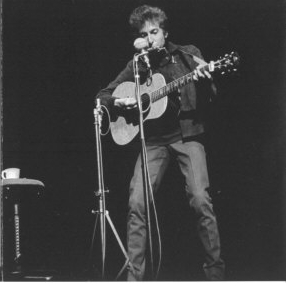
We are then presented with an introspective shift as the narrator now celebrates a feeling of blissful satisfaction: …Don’t the moon look good… Dylan sings …Shinin’ through the trees… following this by the very specific image of …Don’t the brakeman look good, mama/ Flaggin’ down the Double E’s…. which suggests a train (or perhaps two writhing bodies) slowly coming to rest. The following lines: …Don’t the sun look good/ Goin’ down over the sea/ Don’t my girl look fine/ When she’s comin’ after me… Again the narrator seems to take considerable pride in making sure his lover is satisfied. In the last verse the lovers’ ardour cools off as …the wintertime is coming/ The windows are filled with frost… The song ends on something of a cautionary note, with the narrator explaining that … I went to tell everybody but I could not get across… It seems that the ecstasy they have shared is the product of two people who slip into sexual roles with each other with relative ease. Finally the lover reasserts his desire for the woman to enjoy an equally satisfying sexual experience: …I wanna be your lover baby… Dylan sings reassuringly …I don’t wanna be your boss… Then he ends on a note of warning: …Don’t say I never warned you/ When your train gets lost… suggesting that the ecstasy they have shared may be short lived.
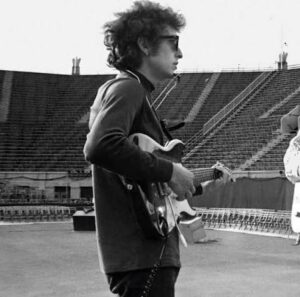
It Takes a Lot to Laugh is a kind of summation of Dylan’s progression through the intricacies of this uniquely American form. Although it can easily be seen to have a sexual theme, sex in the blues is often in itself a metaphor for the desire for liberation. With this song Dylan frees himself from the feeling of being an ‘outsider’ with regard to this form of music. Being able to play and sing the blues effectively involves an understanding of the subtle shadings of ironic humour and the implicit kinds of social and personal expression that it allows. With this song Dylan now sounds like he does not need to try to imagine himself within a particular social and linguistic milieu. He has already crossed over into the specific mental and emotional space that the blues occupies – ‘represented here as a ‘window’ into a calmly philosophical standpoint. His work on this song recalls the soft-spoken, gently ironic blues style of singers like Mance Lipscomb and Mississippi John Hurt. The song itself, with its continually reassuring tones, is a definitive statement of how Dylan’s unique take on the blues has now, after much imitation and the dispensing of frenetic energy, settled into a way in which he can use the lyrical and musical conventions of a form he has now mastered to create songs whose depth of true feeling is such that they can be returned to over and over again.
LINKS
STILL ON THE ROAD – ALL DYLAN’S GIGS
THE CAMBRIDGE BOB DYLAN SOCIETY
Leave a Reply