


THE WATERS OF OBLIVION; TWO MYSTERIOUS SONGS FROM BOB DYLAN’S BASEMENT TAPES (FROM ‘MINSTREL BOY’)
A version of this text appears in Chris Gregory’s MINSTREL BOY: THE METAMORPHOSES OF BOB DYLAN (available here)
a study of Dylasn’s work between 1967 and 1990 – the second part of the ‘Picasso of Song’ trilogy.
“Are we fallen angels who didn’t want to believe that nothing is nothing and so were born to lose our loved ones and dear friends one by one and finally our own life, to see it proved?”
Jack Kerouac, The Dharma Bums (1958)
Cordelia: Nothing, my lord.
Lear: Nothing!
Cordelia: Nothing.
Lear: Nothing will come of nothing: speak again.
William Shakespeare, King Lear Act 1 Scene 1 (1604)
‘Do you know nothing? Do you see nothing? Do you remember
‘Nothing?’
I can connect
Nothing with nothing.
T.S. Eliot, The Wasteland (1926)
WATERS OF OBLIVION
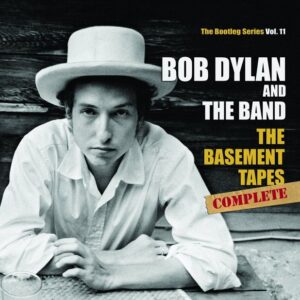
Nothing Was Delivered andToo Much of Nothing are two enigmatic and darkly humorous songs from The Basement Tapes. Both consist of three verses full of rather puzzling statements, held together by distinctive choruses. As with much of the Basement Tapes material, these songs provide a kind of skewed commentary on the rationale behind Dylan’s post-accident rural retreat. It is as if he is delivering secret messages to a knowing audience, winking at us as he does so. In 1965-66 – as he experimented with just how much he could expand the limits of sense in his songs – achieving ‘nothingness’ became a kind of aspiration. In reaching out towards this nebulous conception of liberation Dylan was influenced by the concepts of Zen Buddhism, which he had been introduced to through the work of the Beat poets. With its emphasis on ‘nothingness’ or ‘emptiness’, the philosophical element of Zen implies that all meaning is essentially indefinable as it is continually shifting. Many of his songs could be said to aspire towards achieving such qualities. In Mr. Tambourine Man he wishes to strip away all extraneous distractions so as to …dance beneath the diamond sky with one hand waving free… Visions of Johanna’s participants have …nothing, really nothing, to turn off… At the climax of Like a Rolling Stone he proclaims …If you ain’t got nothin’, you got nothin’ to lose…
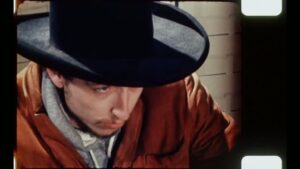
In the mid 1960s Dylan seems to have pushed himself further and further towards this goal of poetic ineffability – even to the extent of being willing to take the stage every night to face a barrage of abuse. There is little doubt that engaging on this ‘impossible quest’, which was undoubtedly fuelled by a not inconsiderable rate of consumption of what he coyly referred to in interviews as ‘medicine’, took a tremendous toll on his mental state and physical constitution. But after his motor cycle accident, his whole approach to song writing went through a metamorphosis. In the initial stages of ‘mucking about in the basement’ he and his compatriots on this new journey began by laying down wildly ragged versions of a wide range of folk, country and blues songs. Dylan was fortunate to be accompanied on this journey by four members of what became The Band; all of them talented multi instrumentalists. Richard Manuel and Rick Danko were also highly gifted singers. The approaches they were experimenting with now were far removed from both the bar room R and B of their formative years and the ecstatic howling rage of the 1966 tour.
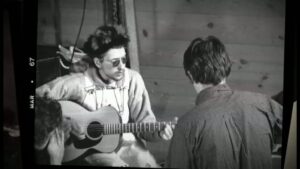
Too Much of Nothing, of which two takes were laid down, follows the pattern of many of the Basement Tapes songs. It features obscure and sometimes apparently nonsensical imagery which is infused with literary and musical allusions. In a reaction against the expansive epic creations of the last few years, Dylan is now writing in a more compressed and suggestive way, mixing bizarre and fanciful poetic concepts with ‘sing-along’ choruses and refrains. His tendency to ‘hide’ behind assumed narrative voices also becomes more prominent. In this song his narrator assumes the voice of a moralist, in the manner of much country and gospel material. In one sense he appears to be ‘preaching’ about the dangers of the kind of lifestyle he had recently been following …Too much of nothing… he begins …can make a feel ill at ease… This is a fairly mild statement, but Dylan’s rather growly vocal, which in many ways is influenced by the deep, rich ‘scary’ sound of the voice of Johnny Cash, already makes the everyday phrase ‘ill at ease’ sound distinctly unsettling.
WATERS OF OBLIVION
In each of the verses, the volume of the instruments and the intensity of the singing rises as Dylan conveys more and more levels of uncertainty. The next lines …One man’s temper might rise, while another man’s temper might freeze… emphasise a feeling of insecurity. Dylan acknowledges that the obsessive search to achieve ‘nothingness’ can have radically different effects on different people. Then he steps into ‘preacher’ mode, declaring …Now its that day of confession/ We cannot mock a soul… He is now ready to ‘confess’ that …When there’s too much of nothing/ No one has control… Thus he acknowledges the dangers of the lifestyle and philosophy he had previously been bound up in, admitting that it involves aspirations which can lead to tragic as well as inspiring outcomes. As the verse ends, Manuel plays a few staccato notes on the piano to lead into the chorus, while the volume of the music rises. 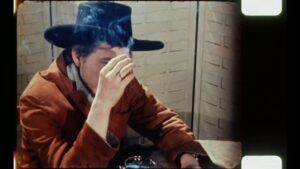
THE WATERS OF OBLIVION
Dylan then delivers one of his most enigmatic choruses: …Say hello to Valerie, say hello to Vivienne/ Give her all my salary on the waters of oblivion… backed by high pitched backing vocals from Manuel and Danko. It might be assumed that ‘Valerie’ and ‘Vivienne’ are typical random Dylan characters but, as a number of commentators have pointed out, these are actually the names of T.S. Eliot’s wives. Given the subject matter of the song, this is surely more than a co-incidence. Dylan’s fascination with ‘nothingness’ in the Zen sense is also connected to the influence of Eliot’s poetry. In Desolation Row he had actually name checked Eliot in a gently mocking way, implying that his poetry was somewhat dry and lifeless. Now, having glimpsed what an encounter with ‘nothingness’ might lead to, Dylan may have changed his mind. In his most famous poem, The Wasteland, one of the key texts of literary modernism which confronts the spectre of post World War One disillusionment, Eliot meditates several times on the meaning of ‘nothing’. In doing so he is also referring back to Shakespeare’s preoccupation with the word in his darkest play King Lear. Dylan’s ‘confession’ here is ironic, given that the concept of ‘nothingness’ implies a universe which is decidedly not under the control of a merciful deity. In the context of the Judeo-Christian tradition, such a realisation can be especially terrifying.
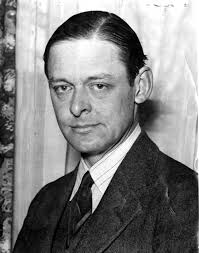
T.S. ELIOT
The waters of oblivion is a phrase which has passed into common usage after being coined by James Ridley, in his Tales of the Genii (1764), a work which was originally claimed to be from an ancient Persian manuscript. In one of the stories the hero Sadak is dispatched by his Sultan to find the ‘waters of oblivion’, which have the magical properties of destroying unwanted memories. The Romantic painter John Martin’s Sudak in Search of the Waters of Oblivion (1812) is one of the best known British paintings of the early nineteenth century. In writing the story, Ridley was updating the Ancient Greek myth of Lethe, one of the rivers of Hades, the underworld. Whoever drank the waters of Lethe (a word which can be literally translated as ‘oblivion’) would experience complete forgetfulness. In Ode to a Nightingale Keats, comparing his state of mind to one who had just taken opium, describes himself as sinking ‘Lethe-wards’. Thus Dylan’s ‘waters of oblivion’ may be a reference to drug addiction. At the same time he seems to be proposing to rid Eliot’s wives of their memories. The assumption appears to be that Eliot, like Dylan, had experienced the negative consequences of ‘nothingness’, not through drug taking but through his deep perception of the ‘godless’ post war world. Such perceptions were especially painful to Eliot, who was a devout Catholic.
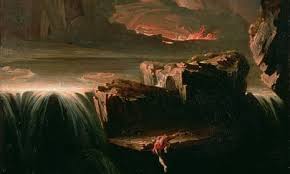
John Martin’s Sudak in Search of the Waters of Oblivion
The rest of the song follows the pattern set by the first verse, with the music again rising to a series of minor crescendos before the choruses. We first hear that …Too much of nothing/ Can cause a man to weep/ He can walk the streets and boast like most/ Of what he’d like to keep… In the second version lines two and four run …Can make a man abuse a king… and …But he wouldn’t know a thing… Either version communicates pretty much the same message. Experiencing ‘nothing’ can change a person’s character, making them sorrowful, abusive and egotistical. Dylan asserts that …Now, it’s all been done before/ It’s all been written in the book… which possibly implies a Biblical connection. The concluding lines are particularly ominous: ….But when there’s too much of nothing/ Nobody should look….which implies that, when ‘nothingness’ takes over, the consequences will be horrifying. If a person is consumed in this way, no religious or scientific text will then be of any use.

In the final verse Dylan begins …Too much of nothing can turn a man into a liar/ It can cause some men to sleep on nails, it can cause others to eat fire… Here he acknowledges that the ‘secret knowledge’ of nothingness can cause religious devotees of certain faiths to indulge in extreme devotional practices which are perhaps just as dangerous as indulging in hard drugs. Finally he concludes …Ev’rybody’s doin’ somethin’, I heard it in a dream/ But when there’s too much of nothing, it just makes a fella mean… Here Dylan assumes a faux-naïve narrative role, juxtaposing the deliberate vagueness of the first line with the use of the highly colloquial term ‘fella’. By using such expressions, and by making the song a musical melodrama, Dylan adds a touch of gallows humour to what is, in places, a very chilling song.

THE WATERS OF OBLIVION
In contrast, Nothing Was Delivered appears to be a quite light hearted piece. Built around a Fats Domino style barrelhouse piano riff played by Richard Manuel, it swings along at an agreeable pace. But it some ways it is darker than Too Much of Nothing. The entire song is presented through the speech of a narrator who is making strong demands on an unnamed person, in a way that does more than just hint at some kind of coercive control. Yet we never find out who either character is, why he is doing this, why he is so determined to get information from the person or what is was that was ‘not delivered’. It might be that he is a police officer or a military figure who is holding the other person captive. The whole song is a kind of interrogation. The chorus …Nothing is better, nothing is best/ Take care of yourself, get plenty of rest… is strangely patronising and possibly threatening. Perhaps there is more torture to come. The scenario is reminiscent of the methods of the Spanish Inquisition, in which those arrested were not even informed of what their supposed ‘crime’ was. It also echoes the similar fate suffered by Joseph K in Franz Kafka’s ultra-paranoid The Trial (1915), a key work of modernist literature.

The most remarkable thing about the song is its almost complete lack of context. Dylan sets up a mystery and quite deliberately does not solve it. He begins …Nothing was delivered, and I tell this truth to you/ Not out of spite or anger, but simply because it’s true… Like all good torturers, he counters his threats with mock-friendliness and honesty. He is actually quite polite as he tells his victim …Now I hope you won’t object to giving/ Giving back all of what you owe…This suggests that there is a debt to be paid. Perhaps the narrator is actually a criminal who has the other person tied to a chair, rather like the comic/horrific scene in Quentin Tarantino’s ultra violent Reservoir Dogs (1992). The victim is told …The fewer words you have to waste on this, the sooner you can go… although there seems to be no reason why the narrator should be believed. In the next verse he confides ….I can’t say I sympathise/ For what your fate is going to be/ For telling all those lies…This is even more ominous and threatening. He demands …some answers for what you’ve sold that’s not been received… and again assures him that he will be released when those answers are forthcoming. The final verse more or less repeats what we have already heard. The narrator/ interrogator demands to know …just what you had in mind/ When you made everybody pay…and reasserts the message that he will not be released until he ‘coughs up’.
The scenario of the song can be applied to a number of different situations as we are, naturally, told ‘nothing’ about the circumstances, except for vague references to the person having not paid his or her debts. We might even imagine that the set up is similar to the occasions when Dylan faced interviewers asking dumb personal questions, to which he generally replied in a highly roundabout fashion. Perhaps the most well known instance of this was in a press conference in Britain in 1965. When Dylan was asked whether he considered himself a song writer or a poet, he avoided placing himself on a pedestal but goggling …Well, I think of myself as more of a song and dance man … Evasiveness has always been one of Dylan’s talents. He has always been skilled at revealing very little (or, preferably, ‘nothing’) about his own private life or his political beliefs.
Leave a Reply