

BOB DYLAN’S SONGS OF SOCIAL PROTEST Part One
EXTRACTS FULL TEXT HERE
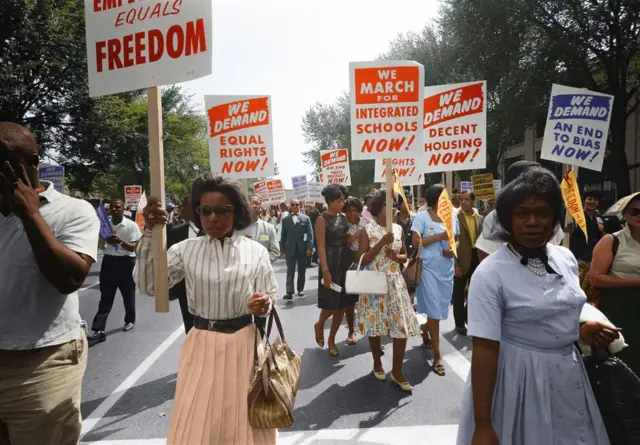
Bob Dylan arrived in the bohemian oasis of Greenwich Village at the age of nineteen in 1961, determined to make his name as a folk performer. He had already absorbed the influence of a whole range of American ‘roots’ music – including the blues, gospel, country, bluegrass and Appalachian folk. But it was as a ‘protest singer’ – a composer of songs that attempted to expose the corruption, inequality, racism and ‘flag waving’ militarism of American society – that he first achieved significant fame. Amid the conventionality of 1950s and early 1960s American society, the Village had a developed a reputation as a Mecca for non-conformists and social activists. It was home to a nascent counter cultural movement which took its lead from radically hedonistic Beat poets and writers like Allen Ginsberg and Jack Kerouac. The time of Dylan’s arrival also coincided with the rise to prominence of the Civil Rights movement and the growing international tensions which threatened to bring the Cold War to a terrifying apocalyptic climax. It did not take him long to take up the mantle of his hero Woody Guthrie as a social and political commentator.
PROTEST SONGS
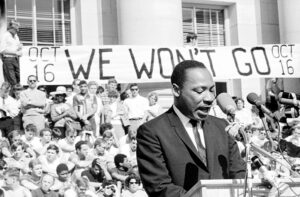
Between 1961 and 1963 Dylan poured out around a hundred songs, many of them ‘topical’. Encouraged by his girlfriend Suze Rotolo, who was involved in various political groups, scouring newspaper reports for suitable topics. He had also become an avid consumer of poetry, rapidly absorbing much of the canon of American, French and British poets. Displaying an incredible intellectual energy for one so young, he was able to synthesise both the radical and the conservative elements of Village culture in a way that no other contemporary folk singer could match. As a keen practitioner of the ‘folk process’, virtually all of Dylan’s ‘protest songs’ rested on melodies that had been adapted from traditional or well known tunes.
MORE PROTEST
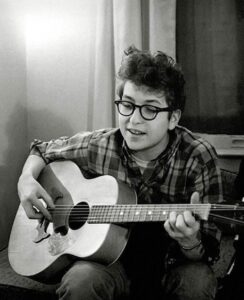
Following the example of Guthrie’s best known works, the focus is always on communicating a strong political or social message. The ‘voice’ of the narrators is usually that of Dylan himself. He usually adopted what sounded to those unfamiliar with folk styles as an uncompromisingly ‘rough’ voice. This immediately alienated many listeners but also helped to establish his own sound as being unique in the world of commercial music and a highly appropriate one for communicating harsh truths. It certainly did not stop him becoming a global star.
OTHER PROTEST SONGS
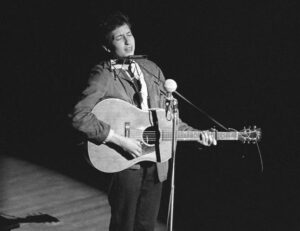
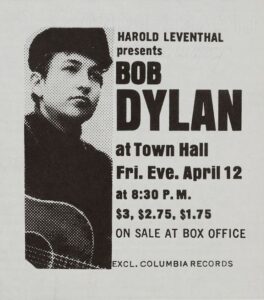
Given that Dylan ‘dashed off’ so many songs during this early period, it is perhaps not surprising that a few of these consist mainly of sloganeering and clichés. (You Been) Hiding Too Long, a song with almost no discernible melody, which was only performed once, at New York Town Hall in 1963, is an attack on false patriotism, addressed to …phony super patriotic people… who are hiding too long behind the American flag… He accuses them of betraying the ideals of the founders of the American constitution with their racism: … You say that the only good niggers are the ones that have died/ Don’t think I’ll ever stand on your side… The same is true of Playboys and Playgirls, another repetitive gospel-influenced ‘sing along’ which attacks ‘fall out shelter sellers’, ‘red baiters and race haters’ and castigates ‘the laughter in the lynch mob’.
This was performed at the Newport Folk Festival in 1963 as a duet with Pete Seeger, who encourages the audience to join in. Other songs in this vein do attempt some minimal poetic effects. Train a-Travelin’, also recorded for Broadside, is another anti-racist rant which (in its first two verses) employs some (rather well worn) metaphors: …There’s an iron train a-travelin’ that’s been a-rollin’ through the years/ With a firebox of hatred and a furnace full of fears…. Long Ago, Far Away (recorded as a Witmark demo) employs irony in a rather obvious way, cataloging a list of ills from the past that are still occurring today and concluding each verse with the refrain…Things like that don’t happen no more nowadays…do they?…
LINKS
STILL ON THE ROAD – ALL DYLAN’S GIGS
Leave a Reply