

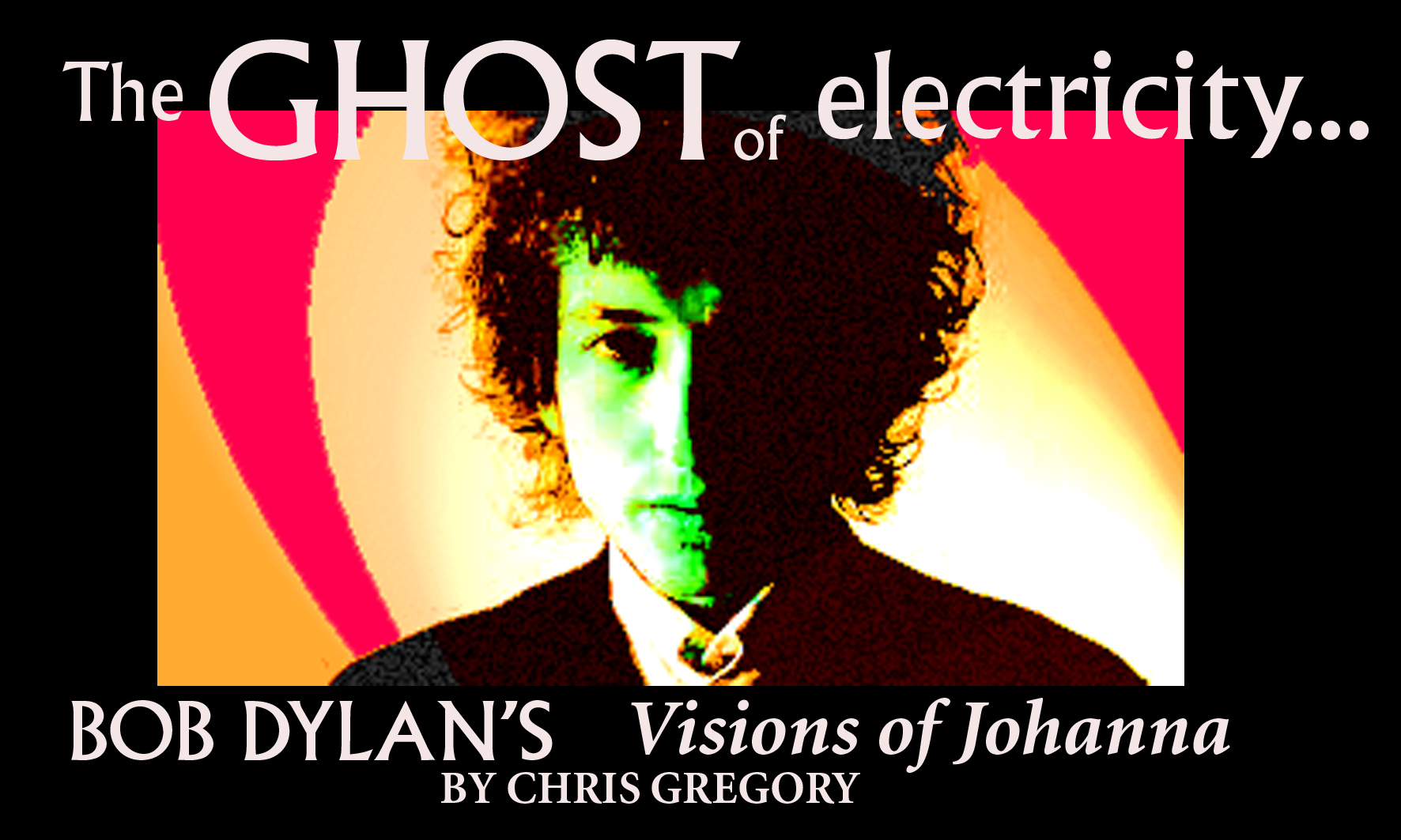
VISIONS OF JOHANNA
EXTRACTS FULL TEXT HERE
Visions of Johanna is generally regarded as one of Bob Dylan’s greatest achievements. It is built upon a haunting melody and is crammed with unforgettable images and highly distinctive wordplay. As one of the standout tracks from perhaps his most acclaimed album, 1966’s Blonde on Blonde, it epitomises the mysterious musical alchemy that he once described so memorably as …that thin wild mercury sound… The highly suggestive and atmospheric lyrics have been compared with those of Keats and Eliot and it is frequently held up as proof of Dylan’s status as a great poet. Yet critics and commentators have argued for decades over its meaning, not to mention the supposed identity of the characters that drift in and out of its splendidly fractured narrative.
Perhaps Mona Lisa herself is lamenting the fact that she is painted only from the waist up and thus ‘can’t find her knees’. In this surreal landscape, which itself is like a modern art painting, dream and reality are merged. We then get another highly dream-like image …Jewels and binoculars hang from the head of the mule… Perhaps this is another painting in Dylan’s imaginary gallery. The entire verse can be seen as a kind of treatise in which, with his tongue very firmly in his cheek, he mocks not only those who attempt to place limited interpretations on great art works but also his own pretensions to be a great artist. The final, and highly ambiguous, line …But these visions of Johanna, they make it all seem so cruel… invites us to pity the ‘little boy’ who is lost in the infinitely unsolvable mysteries that transcendent art, music and poetry are devoted to celebrating. But the edge of irony in Dylan’s voice here expresses the fact that he is not really to be pitied.
VISIONS OF JOHANNA
In the final verses, several new characters make fleeting appearances. We first meet a ‘peddler’ and a ‘countess’ – apparently representing a poor person and a rich person. We could also picture them, like the other characters in the song, as being contemporary figures in the bohemian world that the narrator inhabits – in this case, perhaps a rich heiress who is ‘slumming it’ with the bohemian crowd in Greenwich Village. The ‘peddler’ may be a chancer who is taking advantage of this rich woman, although the countess (probably a social dilettante) is said to be merely ‘pretending’ to care for him. But the peddler is scathing in his justification of his dependence on her: …Name me someone who’s not a parasite… he sneers confidently …And I’ll go out and say a prayer for him… Some commentators have linked the figures in this final verse to the scruffy young Dylan and his former consort, the rather ‘queenly’ Joan Baez, who did much to advance Dylan’s early career. This may be reinforced by the reference to the mysterious and absent figure of …Madonna… who is clearly a stage performer. We are told that …She still has not showed… and we are presented instead with an image of a rusty ‘empty cage’ …where her cape of the stage once had flowed… Like Johanna, Madonna (whose name, of course means ‘Mother of God’) is absent from the scene.
VISIONS…
The line has achieved a strange resonance in subsequent years with the emergence of a ‘real’ Madonna as perhaps the best known female performer of late twentieth and early twentieth century popular music. It now seems that Louise, making her own ‘final bow’ in the song, is about to become involved with the peddler as she delivers the caustic aside in ‘street jive’: …You can’t look at much can ya man?… Louise again appears to be a down to earth or ‘grounded’ character, who is determined to get what she can from her immediate material circumstances rather than wait for the spectral appearance of distant female goddess-like figures.
Leave a Reply