


BRUCE SPRINGSTEEN: STREETS OF MINNEAPOLIS: SINGING THROUGH THE BLOODY MIST…
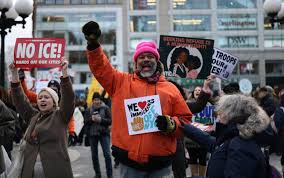
Streets of Minneapolis is a song written and recorded by Bruce Springsteen just a couple of weeks ago, in protest against the killings of civilian protestors by agents of ICE (Immigration and Customs Enforcement). The song follows in the tradition of American protest songs that comment on contemporary events, such as Joe Hill, written by Earl Robinson and Alfred Hayes in 1936, about a murdered union activist, and Strange Fruit, written by Abel Meeropol and recorded by Billie Holiday in 1939, a searing depiction of KKK lynchings. Woody Guthrie, hero and antecedent of both Bob Dylan and Bruce Springsteen, composed many such songs, including Pastures of Plenty, a beautiful but tragic evocation of the fate of poor Okie farmers caught up in the 1930s dustbowl. In the 1950s, Pete Seeger popularised anti war songs like Where Have All the Flowers Gone. In the 1960s Bob Dylan took the genre into the realms of high art with songs like A Hard Rain’s a-Gonna Fall (1963), a devastating and visionary approach to the current fears of nuclear extinction and The Lonesome Death of Hattie Carroll (1964), a withering attack on the racial prejudice of the US judicial system.
STREETS OF MINNEAPOLIS
The late 60s produced many powerful protest songs, such as John Fogerty’s Fortunate Son – an expose of how the rich and influential were able to buy themselves out of being drafted for the Vietnam War, Neil Young’s Ohio, which lamented the killing of student anti war protestors and Country Joe’s I Feel Like I’m Fixin’ To Die, a mockery of pro-war sentiments. Later examples included Gil Scot Heron’s satirical black revolution song The Revolution Will Not Be Televised Paul Weller’s Eton Rifles (1979), a withering attack on the British class system, U2’s Sunday Bloody Sunday (1983) an expose of the destructive violence in the ‘troubles’ in Northern Ireland, Public Enemy’s Fight the Power (1990), which accuses Elvis of being a racist and Green Day’s American Idiot (2004), a direct attack on the post 9-11 Bush administration. In recent years song writers have been inspired to comment on many contemporary events. The murder of George Floyd in 2020 inspired a number of protests, including the somewhat anodyne Ballad of George Floyd by Don McLean (2024) and the Grammy Award winning I Can’t Breathe (2021).
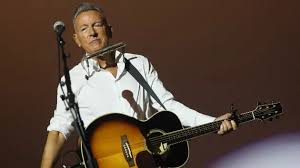
Bruce Springsteen himself has written a number of ‘protest songs’, such as the much misunderstood Born in the USA (1984), a diatribe against the treatment of returning Vietnam vets, Shut Out the Light (1984), which recounts the experience of such a vet suffering from Post Traumatic Stress Disorder and The Ghost of Tom Joad (1995), which laments the resurgence of poverty in modern America. Long Walk Home (2006) updates the theme of Shut Out the Light, as it is narrated from the point of view of a former Gulf War soldier. In recent years he has made many outspoken comments about the Trump regime, ignoring Trump’s description of him as a ‘washed up has been’. But the release of Streets of Minneapolis represents a particularly radical step. Whereas the other songs had been delivered through the personas of particular narrators, here Springsteen leaves no room for ambiguity. The song points a very direct finger at ‘King Trump’ and ICE, who it clearly accuses of cold blooded murder.
STREETS OF MINNEAPOLIS
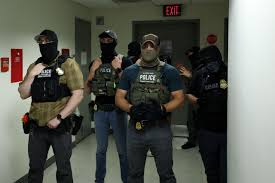
Springsteen sings in a tone of great anger, mixed with bitter sarcasm. The vocals are mixed up front and he pronounces every word clearly. The song has four verses and three choruses and achieves a remarkable balance between direct and poetic expression. This is no easy trick to pull off. We begin with an evocation of the freezing temperatures that protestors had to endure in their anti-ICE marches: …Through the winter’s ice and cold/ Down Nicollet Avenue/ A city aflame fought fire and ice/ ‘Neath an occupier’s boots… The naming of the real street in Minneapolis adds an instant touch of realism. The contrast between the fury of the protestors and their oppressors is expressed in the line …a city aflame fought fire and ice… which uses the double meaning of ‘ice’ in neat contrast to the fiery rage of the citizens. The phrase ‘occupier’s boots’ is almost spat out. Next we hear that …King Trump’s private army from the DHS/ Guns belted to their coats/ Came to Minneapolis to enforce the law/ Or so their story goes… There is no equivocation here, with the last line being delivered with more biting sarcasm.
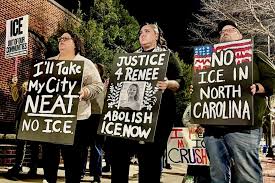
The next verse again contrasts the reality of oppressive tactics against poetic allusions: …Against smoke and rubber bullets/ In the dawn’s early light…. The second line is a direct quote from the US national anthem The Star Spangled Banner, emphasising the alternative view of ‘patriotism’ that Springsteen is espousing here. We hear that …Citizens stood for justice/ Their voices ringing through the night… relatively bland lines which are, however, thrown into harsh relief by …And there were bloody footprints/ Where Mercy should have stood… which employs the personification of ‘Mercy’ – a favourite literary device of the Puritans who founded the USA – and the final lines: …And two dead, left to die on snow-filled streets/ Alex Pretti and Renée Good… Springsteen pulls off the difficult conundrum of actually naming the victims here, who are – in some strange form of ‘poetic’ justice, named ‘Pretti’ (pronounced ‘pretty’) and of course ‘good’. It is almost as if Springsteen’s script has been written for him in some providential way.
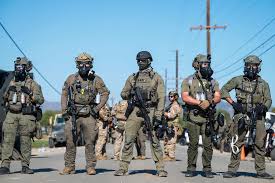
The memorable chorus bears the mark of many other rousing Springsteen epics, from Born to Run to Darkness on the Edge of Town. Again he uses personification: …Oh Minneapolis, I hear your voice, singing through the bloody mist… as if the city itself has been transformed into a kind of living Statue of Liberty. The line …We’ll take our stand for this land … deliberately echoes Woody Guthrie’s great song of ‘alternative patriotism’ This Land is Your Land… while …And the stranger in our mist… appears to refer both to the ICE agents and to Trump himself. The mention of …The winter of ’26… immediately puts the stamp of history on the proceedings.
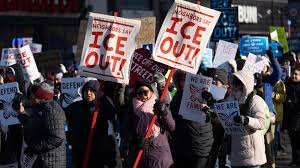
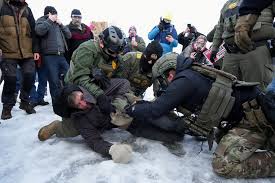
The next verse is equally uncompromising. We hear that …Trump’s federal thugs beat up on/ His face and his chest/ Then we heard the gunshots/ And Alex Pretti lay in the snow dead… Then Springsteen goes for the jugular: …Their claim was self-defense, sir… he cries, adopting the supposed voice of an agent defending himself in a cringingly embarrassing way. Then he spits out the riposte: …Just don’t believe your eyes… again in a tone filled with deep sarcasm and rage …It’s our blood and bones… he sings …And these whistles and phones/ Against Miller and Noem’s dirty lies… eulogising the heroic resistance of ‘the people’ against the government officials who he has no compunction in naming. The juxtaposition of ‘blood and bones’ against ‘whistles and phones’ is one of the song’s outstanding moments, merging poetic lyricism with gripping realism.
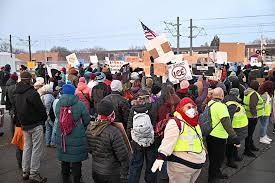
Finally Springsteen lays it clearly on the line: …Now they say they are here to uphold the law/ But they trample on our rights… the image of ‘trampling’ is especially appropriate here with regard to some of ICE’s methods. It also echoes a line from the Civil War anti slavery anthem Battle Hymn of the Republic… (…trampling out the vintage where the Grapes of Wrath are stored…). This connects directly with the following accusations of racism: …If your skin is black or brown, my friend/ You can be questioned or deported on sight… Then we get a summary of the protests, in which Springsteen identifies himself directly with those on the streets: …In our chants of ICE out now/ Our city’s heart and soul persists… The mention of ‘ICE’ is linked to a background chant. Then Springsteen ties it up neatly with a line that draws us back into the final chorus: …Through broken glass and bloody tears/ On the streets of Minneapolis… The song ends with a short recording of a crowd chanting …ICE OUT!…
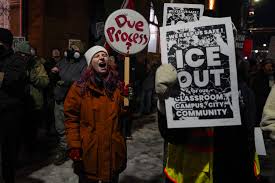
Streets of Minneapolis has already drawn much attention, rising to the top of streaming charts in many countries. It has already been covered by a number of artists and could well soon be chanted from the barricades. In this highly articulate yet rage-filled anthem Springsteen has redefined the form of the protest song for a new era. Despite its almost ‘instant’ composition (in contrast to Springsteen’s often extremely perfectionist attitude to recording) it is not a mere piece of political propaganda but a highly moving comment on the situation that ordinary Americans are now facing every day, with pointed references to the racism inherent in the current situation, balanced by its more subtle allusions to the controversial discourse of American ‘patriotism’.
Leave a Reply