

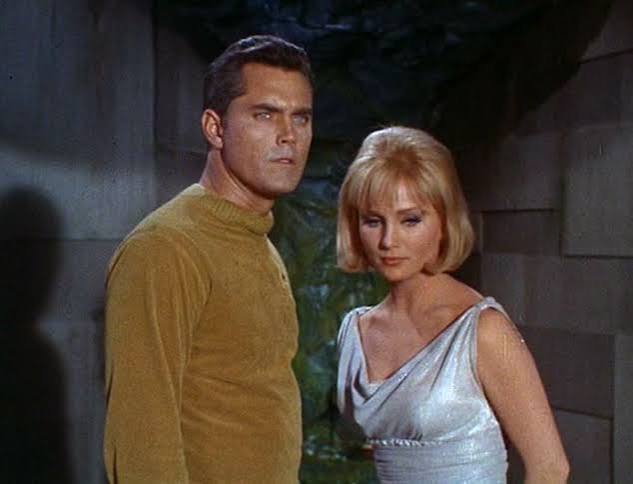
THE CAGE: ‘A NEW ADAM AND EVE’
The Cage was the first pilot episode of Gene Roddenberry’s proposed Star Trek series. Apart from Leonard Nimoy as Spock, it features an entirely different cast to that of the original series and was never broadcast in the 1960s. Only in 1988 did a full version appear. Much of the material was later recycled in the two part episode The Menagerie. It was rejected by the NBC network for being ‘too cerebral’, which says a lot about their corporate mentality at the time, and how notions of what an audience is capable of understanding and appreciating have shifted since those days. Yet, by the standards of 1964, when it was made, the episode had a remarkably psychological focus which was very unusual in the TV landscape of the time. Although it contains a few obligatory fist-fights, it lacks the strong action-adventure dynamic which characterises the series that was eventually made.
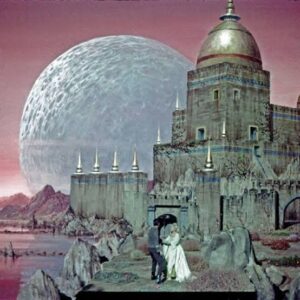
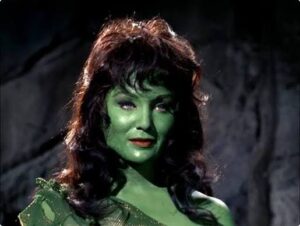
The episode, which was written and produced by Roddenberry himself, has a particularly strong color palette, a feature which was continued in perhaps a slightly muted way when the series came to be made. With a plot centered on illusions created by the highly-evolved Talosians, it has an almost hallucinatory quality which might have made more sense to the general public in the psychedelic era of a few years later. Director Robert Butler, a specialist in making pilots, imbues the episode with a visual intensity which few episodes of the actual series achieved. He was helped by the fact that the show had a budget of around $600,000 dollars – roughly three times as much as the episodes in the series.
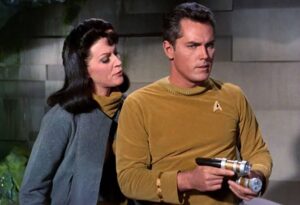
The visual effects and background scenery look surprisingly convincing for a production of this era, while the prosthetics applied to the Talosians are equally impressive. Much of the look of the episode is heavily influenced by two classic 1950s science fiction films, Forbidden Planet (based on Shakespeare’s The Tempest and also featuring a young woman who has grown up without companions on a planet) and This Island Earth, whose futuristic interior spaceship designs anticipate those of the Enterprise. The design of the ship and technological devices like phasers (referred to here as ‘lasers’) is also credibly futuristic and the score by Alexander Courage is highly dramatic and effective.
THE CAGE
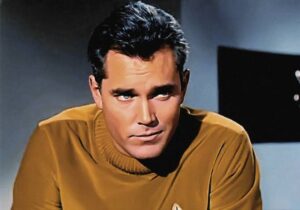
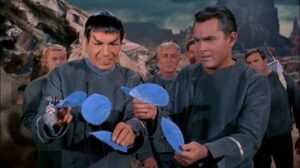
The well-known film actor Jeffrey Hunter (who had played Jesus in King of Kings and John Wayne’s sidekick in The Searchers) as Christopher Pike also communicates a rather intense, serious presence. He is presented as being disillusioned with his role as captain and burdened down by the responsibility of having to order his crew to risk their lives on dangerous missions. While he is subjected to a series of illusions, he always maintains a highly logical, scientific and almost Spock-like perspective. Spock himself, who appears to be the science officer, gives a few explanatory speeches but plays a relatively minor role. His origins are not revealed and he is even seen smiling and getting excited at times.
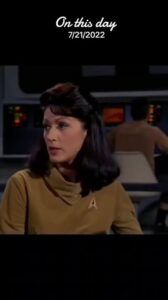
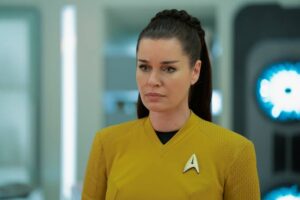
The second in command, referred to as ‘Number One’ is an unemotional woman, of undisclosed and presumably alien origin, effectively played by Majel Barrett, later to be cast as Nurse Chapel in the series and Lantana Troi in The Next Generation. The other main character in the crew is Dr. Philip Boyce (John Hoyt), whose main role seems to be that of a friend and counsellor to Pike, in a similar manner to the role that would eventually be filled by McCoy. The crew, however, lacks the racial diversity of the series, perhaps indicating Roddenberry’s initial caution about what would become a very notable feature of Star Trek.
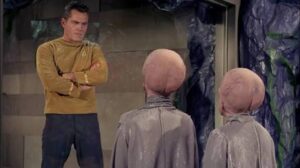
Although The Cage is slower-paced than most episodes of the series, it already features many of the conceptual and narrative elements that will later characterise Star Trek. The theme of emotion versus logic is already present, although these qualities are distributed rather differently within the crew. The Talosians, who at first appear to be threatening and controlling, are eventually shown in a more sympathetic light – a typical Star Trek trope. They are also the first race we see of super-intelligent, almost God-like aliens – another fairly common trope in all the succeeding series.
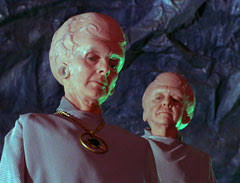
It is finally revealed that the Talosians’ society and planet were destroyed thousands of years ago in a nuclear war – a clear example of Roddenberry’s determination to ‘slip in’ references to contemporary issues. As a result the Talosians – although they have long lives – have become infertile. The episode was made only two years after the Cuban Missile Crisis, when the world stood on the edge of nuclear annihilation. A similar explanation had been provided for the destruction of an environment in the early Doctor Who story The Dead Planet (1963), which marked the first appearance of the Daleks. There is, as yet, no mention of ‘Starfleet’ or any galactic Federation.
THE CAGE
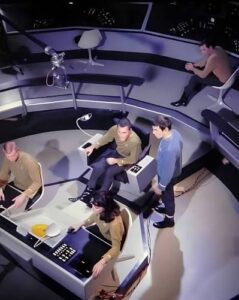
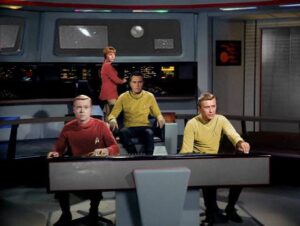
A number of highly inventive visual features and plot devices that would later distinguish the series are already present. The device of ‘beaming down’ – a rather brilliant invention designed to cut costs and tedious ‘landing’ scenes – is already present, as are Spock’s soon-to-be-iconic ears and eyebrows. The idea of warp drive, here referred to as ‘the time barrier’, is included. There is a reference to planets with a breathable atmosphere as ‘Class M’, which would be used throughout Star Trek. The layout of the bridge of the Enterprise looks remarkably similar to that of the series and the presentation of futuristic TV screens, control panels, automatic doors and computers is very sophisticated and quite genuinely ‘futuristic’ for the time. The crew are already using the flip-up communicators that would – many years later – strongly influence the design of mobile cell phones. The inspired work of designers for such objects would contribute considerably to the eventual success of the entire franchise.

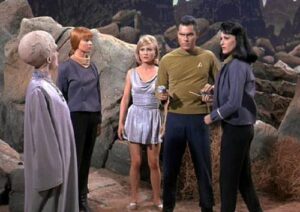
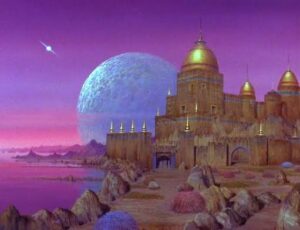
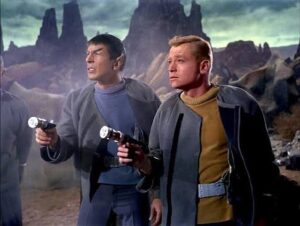
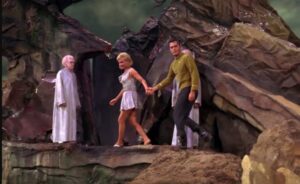
The plot of the episode is certainly intriguing. Investigating a crashed spaceship on the unknown planet Talos IV, the landing party is confronted by what appear to be a group of ageing, rather ragged-looking scientists – supposedly the remnants of the crew of the ship. Among them is a beautiful eighteen year old girl called Vina, who takes Pike by the hand and leads him off towards a rock formation, which suddenly opens up. One of the Talosians appears and zaps the captain. For most of the episode he will remain imprisoned in his invisible ‘cage’, within which he is subjected to a series of illusions. The crew’s attempts to blast their way in to save him with a giant laser gun are ineffective. It seems that the Talosians have advanced mind control powers.
Pike’s captors’ efforts are designed to make him fall in love with Vina, so that – as we learn later – they can repopulate the planet with what they regard as an inferior ‘slave race’. Vina does her best to entice him. Pike is transported into several unreal scenarios- one in a medieval castle in which she is threatened by a huge ‘barbarian’ wielding an axe (cue the fist fight!) and another in what is apparently a charming domestic scene in what seems to be a familiar location near Pike’s home in which his ‘wife’ Vina is preparing a picnic for them. These scenarios are designed to make him protective and sympathetic to her. They are then transported to a rather ‘sleazy night club’ setting in which Vina, in the form of a green-skinned Orion ‘slave girl’, performs an erotic dance. This is intended to provoke Pike’s lust. When this fails the Talosians beam both Number One and the young female Yeoman Colt into The Cage, hoping that Pike will now choose one of them to be his ‘Eve’. But Pike is too strong-minded to fall for any of these tricks.
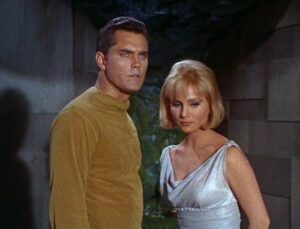
Eventually Pike discovers that the Talosians’ mind control is somewhat limited and that they cannot handle extreme emotions. He tricks their main protagonist, the Keeper- into the Cage and threatens him physically. The Talosians, who have now downloaded all the ship’s data, recognise that Earth people are more intelligent, resourceful and advanced than they expected. They fail to persuade Pike to stay with Vina to become their ‘Adam and Eve’. After Number One threatens to set her ‘laser’ to explode in order to kill herself, they eventually relent, allowing him to return to the ship, acknowledging that the failure of their scheme will eventually result in their own extinction.
It is then revealed that Vina herself is in reality a very disfigured middle-aged woman who was very badly hurt in the crashed spaceship, while the party of scientists were all, in reality, killed in the crash. Vina explains that she cannot leave the planet. The Talosians then provide her with an illusion of a Pike-like figure, with whom she happily walks off with into the distance.
The plot, of course, has a number of weaknesses, which illustrate both the strengths and the weaknesses of Roddenberry’s writing. Nobody actually dies in the course of the episode. There are no convenient ‘red shirts’ to kill off here. The focus is always on the psychological battle between Pike and the Talosians. The stoical Pike is a strong character who never seems to be tempted to stay on the planet and his eventual ‘beating up’ of a Talosian is somewhat unconvincing. The rest of the crew appear to be somewhat ‘clueless’ about how to resolve the situation and Spock never comes up with one of the ingenious ruses which he will later deploy with so much efficiency. He is even prepared, at one point, to abandon Pike and Number One and order the Enterprise to depart. Despite its many ingenious plot devices and its surprisingly thoughtful depictions of the aliens, the plot resolution eventually demands resorting to ‘fisticuffs’ in a conventional TV manner. It should be noted, though, that nobody actually dies in the course of the episode. There are no convenient ‘red shirts’ to kill off here. The focus is always on the psychological battle between Pike and the Talosians.
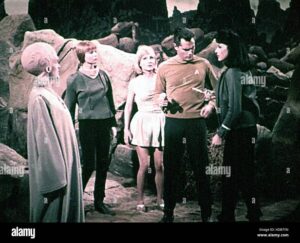
The sexual politics of the episode also illustrates the kind of contradictions in this area which would be a continuing feature of the original series. One the one hand, Roddenberry takes the highly unusual step of placing a woman as First Officer of the ship. Number One, like the other crew members, are not especially sexualised. The female crew members in fact wear trousers, in contrast to the micro-skirts they later appeared in. Yet the character of Vina is represented as a series of female stereotypes – initially as a rather sexy ‘teen’ dressed in a skimpy Hawaiian-type ‘grass skirt’, as a helpless ‘maiden’ in medieval dress, as a wholesome and lovingly submissive wife and (in the erotic dance scene) as a shameless ‘slut’. Eventually she happily accepts the ‘fake Pike’ as her lover and companion, suggesting that she is somewhat, in the parlance of the day, a ‘dumb’ brunette.
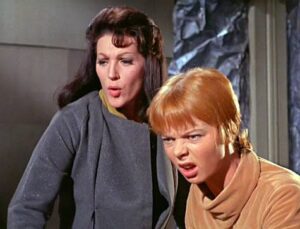
A couple of what seem to be rather out-of-place lines of dialogue confuse the matter further. At one point Pike acts rather aggressively to the hapless Yeoman Colt, complaining that he …finds it hard to accept having a woman on the bridge… Number One naturally raises an eyebrow. He turns to her and tells her …Of course, you’re different… Later, when both females are in the Cage with him, the mind-reading Talosian reveals that Number One’s unemotional character is in reality just as facade and that in reality she is attracted to Pike. The shot of Number One looking suitably embarrassed reveals that this is not just another trick on the aliens’ part. Before the ship leaves at the end of the show, Yeoman Colt wonders aloud …which one he would have picked as his Eve… Thus, these female characters are revealed, despite their supposed autonomy, to be disguising the fact that in reality their view of Pike is not merely ‘professional’.
Gene Roddenberry’s vision of the future, which would be revealed as the series continued, was – at least in theory – one in which all humans were seen as equally capable and responsible. He would later populate the Enterprise with a racially diverse crew and many of the human-alien interactions in the episodes are clearly ways in which issues such as racism and sexism could be dealt with. But the rather odd contradictions in representations of women here would continue to be what in the modern era can be viewed as rather problematical. Although Roddenberry was in favour of representing women in positions of authority and thus demonstrating that could be the intellectual equals of men, many of the women in Star Trek who appeared as guest stars (and often as Kirk’s ‘love interest’ of the week) are portrayed as heavily sexualised stereotypes.

The Cage remains a fascinating watch. It looks impressive for a 1964 TV production and has a genuinely compelling sci-fi premise. The story is, again by the standards of the day, bold and imaginative. Jeffrey Hunter and Majel Barrett’s performances are very convincing. But it is easy, at least in retrospect, to understand why NBC’s execs turned it down as a series pilot, considering it to be rather too psychologically based to be delivered to a mainstream audience. It is almost entirely lacking in humour and the relationships between the crew members lack warmth. They appear to display little real warmth towards each other and thus do not form any kind of ‘surrogate family’. Unlike the later cast, they are just not ‘loveable’ enough to support a long-running show, in which the audience can identify with the characters. Hunter’s performance, though very consistent and skilful, is basically cinematic rather than televisual. His Pike is a ‘cold fish’.
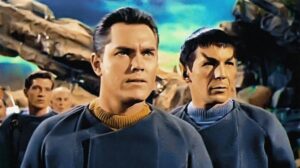
The NBC executives also struggled with Roddenberry’s ideas on diversity, worrying that a popular audience would not accept a woman as second in command. They also fretted about Spock, whose appearance appeared to them to be rather ‘satanic’. It seemed that the series would never take off. But a great deal of money had already been invested in the show in terms of set construction, which would have represented a considerable loss, especially for Desilu Productions, the independent production company which had provided most of the finances.
This proposal was a virtually unprecedented step in American TV, as it involved considerable financial risks. But Desilu was now struggling to make ends meet and could not afford to let their investment be wasted. Lucille Ball, trading on her status as one of US TV’s major stars turned company mogul, eventually persuaded the network to support a second pilot, having conceded that many changes would need to be made. As a ground-breaking figure in TV history herself and someone who understood Roddenberry’s desire to make a quality production, she gave him enthusiastic support, thus saving what would later become such a massive franchise from premature extinction. Unlike the unfortunate Talosians, Star Trek would not become extinct.
References were later made to Pike as the pre-Kirk captain of the Enterprise in The Next Generation’s The Measure of a Man and Deep Space Nine’s Tears of the Prophets. In the movie Star Trek, made in the 2010s by J.J. Abrams (later referred to as existing in the ‘Kelvin timeline’) Pike, played by Bruce Greenwood, is firmly established as a mentor to Kirk, before he is assassinated in the sequel Into Darkness. In the second season of the first of the ‘nu-Trek’ series Discovery (a series set before the events of TOS), Anton Mount’s performance as Pike (along with that as Ethan Peck as a younger Spock) was so impressive that fan pressure led to him becoming the captain in another prequel, Strange New Worlds.
THE CAGE
In both cases, the portrayal of Pike was very different to Hunter’s original portrayal. Instead of being the troubled soul of The Cage, Greenwood’s Pike was a warm and reassuring role model for Kirk. In Strange New Worlds, Mount’s Pike is the franchise’s most informal and frequently humorous leading man, always ready to put a friendly arm around the less senior members of his crew.
Despite the fact that The Cage was abandoned as the model for Star Trek, it thus subsequently became accepted as an important element in the canon of the franchise. First viewed in incomplete form in Star Trek conventions in the early 1980s, it became popular with a fan base which acknowledged that, in terms of the Star Trek universe, the events depicted in this ground breaking, if somewhat mystifying and strange episode, ‘really happened’.
LINKS
SOME WEBSITES
TREK CORE https://www.trekcore.com/
TREK NEWS https://treknews.net/
TREK MOVIES https://trekmovie.com/
TREK TODAY https://trektoday.com/content/
TREK ZONE https://trekzone.org/1701/
Ex-ASTRIS-SCIENTA https://www.ex-astris-scientia.org/
KLINGON LANGUAGE INSTITUTE https://www.kli.org/
MEMORY ALPHA https://memory-alpha.fandom.com/wiki/Portal:Main
PHASERS http://www.phasers.net/
PRIORITY ONE https://priorityonepodcast.com/
STAR TREK MINUTAE https://www.st-minutiae.com/
STAR TREK PROP AUTHORITY http://www.startrekpropauthority.com/
SOME VIDEOS
JESSE GENDER https://www.youtube.com/watch?v=6CDek93Fre8&t=399s
STEVE SHIVES https://www.youtube.com/watch?v=HS3jhfLQ0rE
ORIGINAL SERIES CLIPS https://www.youtube.com/watch?v=Ej-HOuGSE5I&list=PLCLqRWV1gU7w
RANKING TOS https://www.youtube.com/watch?v=HJ3-o1YwSGg&t=226s
10 DUMBEST THINGS IN TOS https://www.youtube.com/watch?v=U-AJNJbO26M
ENTIRE STORY https://www.youtube.com/watch?v=Jcs-cW4N3R8&t=67s
SUPERCUT https://www.youtube.com/watch?v=ELH8kcTFxvI&t=2050s
WHAT CULTURE https://www.youtube.com/watch?v=Wgx6eP6I3fI
WORST EPISODES https://www.youtube.com/watch?v=lZ6Z11pkjdk
Leave a Reply