

VIDEO PODCAST: SONGS OF SOCIAL PROTEST Part 3
EXTRACT FULL TEXT HERE
The melodic ballads Seven Curses and Percy’s Song, which were considered for the The Times album, both focus strongly on the issue of justice. Corrupt and unsympathetic judges are at the centre of both narratives. Seven Curses is set in some indeterminate place in a past era, possibly in the American West. It tells the story of a young woman who reluctantly agrees to spend the night with a corrupt judge in order to save her father from hanging. The judge duly takes advantage of her but hangs the father anyway. This is a very similar plot to Shakespeare’s Measure for Measure and a number of traditional ballads are based on variants of the story. Sometimes the corrupt official is a hangman rather than a judge, as in Leadbelly’s Gallows Pole, later adapted by Led Zeppelin. Dylan relates his version with great lyrical economy over a pretty finger-picked guitar figure and a melody based on Anathea, an English version of the Hungarian folk song Féher Anna (White Anna). The song has been covered a number of times, most notably by folk artists June Tabor and the Oyster Band and Joan Baez.
SONGS OF SOCIAL PROTEST Part 3
The song contains a number of memorable phrases. We learn that …When the judge saw Riley’s daughter/ His old eyes deepened in his head… giving us a graphic image of this lustful and evil old man. Dylan employs some examples of poetic pathetic fallacy: …The gallows shadow shook the evening/ In the night a hound dog bayed/ In the night the grounds were groanin’/ In the night the price was paid… He again skillfully places dialogue in the mouths of the characters. The lascivious judge cackles …”Gold will never free your father/ The price, my dear, is you instead!”… Old Reilly tells the girl not to accede to the judge’s demands. He says …My skin will surely crawl if he touches you at all… but sadly she ignores him. The last two verses enumerate the …seven curses on a judge so cruel… which consist of a rather odd list – one doctor, two healers, three eyes, four ears, five walls, six diggers and seven deaths. The unnamed narrator wishes him to be in such great pain that …seven deaths shall never kill him… The choice of seven does, however, seem a little random, and the ending of the song is somewhat anticlimactic. Dylan falls into the trap of delivering his own judgement on the situation, which is arguably unnecessary as the moral outlines of the story have already been clearly delineated.

Percy’s Song also features another unproductive encounter with a judge. The narrator visits the judge to plead for clemency for an unnamed friend (presumably ‘Percy’), who has been sentenced to ninety nine years in jail for accidentally crashing a car in which the passengers were killed. The judge, however, is rude and unresponsive. The song conveys deep sadness and despair but does so with admirable restraint. The beautiful flowing melody is derived from Paul Clayton’s song The Wind and the Rain; itself a variant on the traditional Scottish murder ballad The Twa Sisters. The song is also distinguished by its compelling refrain. Every second line in each of the sixteen verses runs …Turn, turn again… while every fourth line (except for in the last verse) is …turn, turn to the wind and the rain… This is reminiscent of Shakespeare’s song When That I Was a Tiny Little Boy, sung by the jester in Twelfth Night, which has a similarly structured use of the lines …With hey, ho, the wind and the rain… and …For the rain it raineth every day… Dylan’s version was not released until it was included on the collection Biograph in 1985 but the song was popularised by Fairport Convention on their album Unhalfbricking, in which lead vocalist Sandy Denny delivers a truly spellbinding performance which brings out the song’s mixture of emotions with great power and sympathy.
Much of the effectiveness of Percy’s Song lies in the way that the narrative itself is related in such a clear and unfussy way. The song begins with the portentous …Bad news, bad news, came to me where I sleep… The opening verses consist of a conversation between the narrator and an unnamed mutual acquaintance who tells him that …one of your friends is in trouble deep… The conversation is edited down to the essentials. The friend merely states …Joliet prison and ninety nine years… and later …Manslaughter in the highest of degrees…. The narrator then writes to the judge to arrange an appointment. The conversation with the judge is handled in a similarly minimal manner. The narrator is quite direct: “Can you tell me the facts”, I said without fear… …that a friend of mine would get ninety nine years”… But the hard hearted judge is not swayed by his appeal. After he states the bare facts of the case, we hear that he …spoke out of the side of his mouth… citing the testimony of a witness that …left little doubt…

The narrator‘s further appeals such as: ….Ninety-nine years, he just don’t deserve… and …What happened to him could have happened to anyone… fall on deaf ears. We are told that the judge …jerked forward and his face it did freeze… The narrator walks away in a state of sad incomprehension. The song ends with a dramatic variation on the established refrain: …And I played my guitar through the night to the day/ Turn, turn, turn again/ And the only tune my guitar could play/ Was ‘Oh, the Cruel, Rain and the Wind’… The only conclusion is that we are all subject to the ‘cruel’ vagaries of life. Injustices happen but sometimes we are powerless to reverse them. The anthropomorphised guitar, that ever-trusty source of comfort, knows this well. Percy’s Song clearly demonstrates that Dylan’s skills as a storyteller in song have become more nuanced. This time he does not deliver any curses. But by telling the story in such a relatively detached way, he makes the tragic nature of the tale more relatable.

SONGS OF SOCIAL PROTEST Part 3
The Ballad of Hollis Brown, which was included on The Times, makes its point with stark and devastating clarity. It relates a tale of the fate of a poor farmer in South Dakota who suffers from crop failure, which threatens him and his family with starvation. The pressure builds on Hollis until he kills his wife, his five children and then himself. The song is a highly dramatic and atmospheric morality tale which builds inexorably towards its tragic ending. It also effectively illustrates how Dylan has begun to combine his various influences. Although it is called a ‘ballad’ it uses the typically repeated lines and rhythmic guitar strumming that characterise the blues. This is partly because, in terms of its melody and approach, it is to some extent modelled on the version of the traditional murder ballad Pretty Polly, which was recorded by the blues influenced Appalachian singer and banjo player Dock Boggs. Dylan played this song several times in the folk clubs in 1961, in a version based on Boggs’ model.
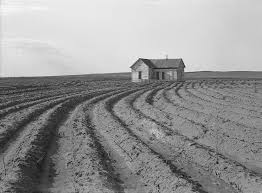
As with John Brown and Seven Curses, we are not told where or when the story of Hollis Brown takes place. We could be in the Wild West of the nineteenth century or the Depression of the 1920s and 30s. Dylan may, however, have drawn the story from matters that were very much closer to home, both in terms of time and location. The song is set in South Dakota, which borders on Dylan’s home state of Minnesota. In the 1950s the state experienced an outbreak of black stem rust, devastating the wheat harvest. The fictional ‘Hollis Brown’ could well have been one of the farmers who suffered. However, the lack of historical context adds to the atmosphere of the song and makes its moral lessons more universal. Dylan played versions of Hollis Brown throughout his career, often with full band backing, with around 200 performances on the Never Ending Tour between 1988 and 2012. It was also rerecorded in the studio in 1993, with Mike Seeger on Dock Boggs-style banjo. Many cover versions exist, by artists as diverse as Barb Jungr, Iggy Pop, Nina Simone and The Neville Brothers, its use of a basic blues format making in adaptable to rock, blues and jazz arrangements.
The song begins with the ominous sounding repetitive blues riff that will be repeated throughout, reflecting the buildup of tension. The terse narrative begins …Hollis Brown, he lived on the outside of town… (repeated) …with his wife and five children and his cabin broken down… The name ‘Hollis Brown’ (which may have been chosen to facilitate the internal rhyme) is not mentioned again. We also never hear the names of his family. Dylan then switches to a rather intimate second person address. It is as if the narrator is a ‘fly on the wall’ at these events, or possibly a voice inside Hollis’ head. We hear that …You looked for work and money/ And you walked a ragged mile… which echoes the nursery rhyme There was a Crooked Man, who lives with a ‘crooked cat and a crooked mouse’ in a ‘crooked house’. Hollis himself is certainly such a ‘crooked man’, not in the sense of criminality but in the state of his mental health, as we shall learn. The next lines are especially shocking: …Your children are so hungry/ That they don’t know how to smile…
Dylan then increases the tension by switching to the present tense for the rest of the song. The throbbing blues riff mirrors Hollis’ pounding heartbeat as he descends into panic. The next few verses alternate between harrowing descriptions of how members of the family react to the situation and the distanced, unemotional narrative voice. We hear that :…Your baby’s eyes look crazy now/ They’re a-tugging at your sleeve… and later …Your baby’s a-crying louder now/ It’s a-pounding on your brain… and ..Your wife’s screams are stabbing you like the dirty driving rain… while …The rats have got your flour/ Bad blood it got your mare… and …Your grass is turning black/ There’s no water in your well… Then we get perhaps the most shocking lines of all: ….You prayed to the Lord above/ “Oh please send me a friend” … is followed by …Your empty pockets tell you that you ain’t got no friends… This is a godless universe. There will be no divine intervention to save Hollis and his family. Coyotes (animals notorious for feeding on the kills of other creatures) howl in the distance like devils. Hollis is quite literally in hell.
It is perhaps this lack of divine guidance that finally drives Hollis to his terrible act. Dylan uses repetition in successive verses to build up the pressure. In a couple of intense cinematic ‘close ups’ we are first told that …Your eyes fix on the shotgun/ That’s hanging on the wall… then …Your eyes fix on the shotgun that you’re holding in your hand… The last two verses are especially poignant …Your brain is a-bleeding/ And your legs can’t seem to stand… indicates that Hollis is experiencing a complete mental breakdown. The repetition of the word ‘seven’ now dominates the narrative. There are …seven breezes a-blowin’/ Around your cabin door… (a line which echoes Stephen Foster’s famous ballad Hard Times, another song about rural poverty, which Dylan will later cover). Then we hear that …Seven shots ring out/ Like the ocean’s pounding roar… This ‘pounding’ of the ocean is reminiscent of both the crying of the baby and Hollis’ own heartbeat. The murder itself is reported as if we are watching a long shot of the cabin in the distance as if, in this movie, the act itself is too terrible to show.
If we are in any doubt as to what has taken place, Dylan spells it out …There’s seven people dead on a South Dakota farm… clearly indicates that Hollis has killed his wife, his five children and finally himself. The concluding line puts the story in a wider context: …Somewhere in the distance/ There’s seven new people born… indicating that this awful event will soon be forgotten. Perhaps it will merit a few lines in a newspaper. Thus Hollis stands as a symbol of all the victims of poverty, war and starvation throughout history. His death has, of course, occurred in a very rich country. Thus the song can be interpreted as a protest against the lack of support for struggling farmers (and poor people in general) in the United States, with its very limited welfare system. The only ‘god’ here is Money…
LINKS
STILL ON THE ROAD – ALL DYLAN’S GIGS
THE CAMBRIDGE BOB DYLAN SOCIETY
Leave a Reply