

The MINSTREL BOY Book Tour 2025
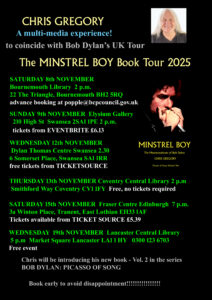
Hi folks here’s the dates for my forthcoming Book Tour. I will be introducing MINSTREL BOY
and the PICASSO OF SONG trilogy and performing excerpts from the book. Hope you can come!
The tour has been arranged to co-incide with Dylan’s upcoming UK tour and many of the venues are
those in which he is playing the same evening.
1) SATURDAY 8th NOVEMBER Bournemouth Library 2 p.m.
22 The Triangle, Bournemouth BH2 5RQ Contact popple@bcpcouncil.gov.uk
Advance booking required but free to attend max capacity 50- they will set up booking form
2) SUNDAY 9th NOVEMBER Elysium Gallery Swansea 2 p.m.
Contact Scott Mackay bar@elysiumgallery.com 07932077898
210 High St Swansea SA1 1PE
tickets from EVENTBRITE £6.13
3) WEDNESDAY 12th NOVEMBER Dylan Thomas Centre Swansea 2.30
6 Somerset Place, Swansea SA1 1RR 01792 463980 capacity about 30.
free tickets from TICKETSOURCE
4) THURSDAY 13th NOVEMBER Coventry Central Library 2 p.m
Smithford Way Coventry CV1 1FY free event
5) SATURDAY 15th NOVEMBER Fraser Centre Edinburgh
info@thefrasercentre.com
£5 tickets available online at TICKETSOURCE
6) WEDNESDAY 19th NOVEMBER Lancaster Central Library 5 p.m
Market Square Lancaster LA1 1 HY free event
REVIEW OF: CHRIS GREGORY, MINSTREL BOY: THE METAMORPHOSES OF BOB DYLAN
https://rollason.wordpress.com/2025/09/08/review-of-chris-gregory-minstrel-boy-the-metamorphoses-of-bob-dylan/
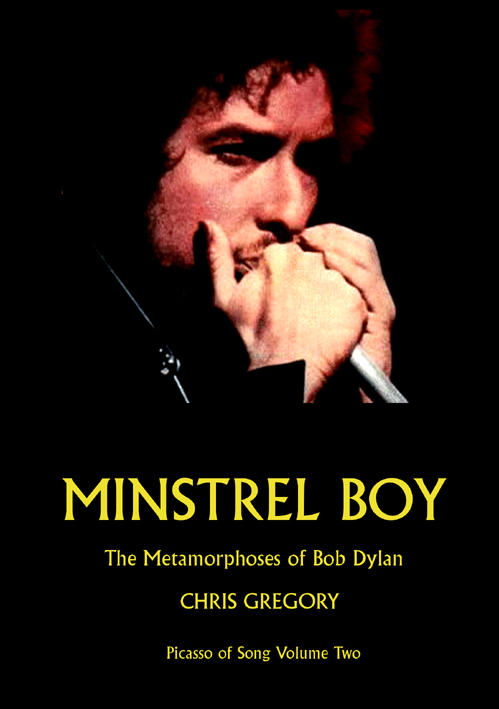
CHRIS GREGORY, MINSTREL BOY: THE METAMORPHOSES OF BOB DYLAN,
London: Plotted Plain Press, 2025, 450 pp. ISBN 978-0-955-7512-6-4
This substantial tome is the second volume of Picasso of Song, a projected trilogy by the author whose first volume, Determined to Stand: the Reinvention of Bob Dylan, won acclaim when it came out in 2021. The sequence of the three parts is reverse chronological: Determined to Stand covers ‘the 1990s to the 2022s’, while this second volume takes as its time range ‘1967 to the early 1990s’. Named after an obscure Dylan song first aired on Self Portrait in 1970, Minstrel Boy places under the microscope the following faces or phases of the artist’s career: withdrawal to the country (The Basement Tapes, John Wesley Harding, Nashville Skyline, Self Portrait, New Morning, Planet Waves); the return to fame and fortune (Blood on the Tracks, Desire, Street Legal); the adoption of born-again Christianity (Slow Train Coming, Saved, Shot of Love); and the post-evangelical phase including Infidels, Oh Mercy and more, up to Under the Red Sky. Interspersed with album and song analysis are bouts of first-hand reportage of key live performances or other events. As with the first volume, Gregory analyses for the period covered every song from every studio album, plus a significant number of additional tracks. There is a significant methodological variation from the first volume, as the song analyses are here ordered by album rather than by theme.
The volume begins with an introduction chronicling the celebrated Isle of Wight concert of 1969, the event which reaffirmed Dylan’s presence on the world stage following his lengthy absence in the wake of the motorcycle accident of 1966: already, the detailed song-by-song treatment offers a foretaste of what the book has in store. There are no footnotes, but the end matter includes an index (lacking in the first volume), a detailed bibliography of works by and about Dylan, a webography and an exhaustive discography.
It is taken as axiomatic that Bob Dylan is both popular entertainer and poet, and the two facets are privileged in turn in, respectively, the concert reviews and song text analyses. The facet of poet is underlined by the quote from Charles Baudelaire ‘s ‘The albatross’ that serves as epigraph to the book. Further epigraphs to chapters quote Edgar Allan Poe (‘The Poetic Principle’, 167), Rimbaud (the famous ‘I is another’ letter, 327) and Baudelaire again (‘Correspondences’), 253. Poe reappears in an evocation of ‘Man in the Long Black Coat’ (384) and in an interview on poetic inspiration cited on the last page (422). For Gregory ‘Dylan’s “song poetry” is multidimensional’(270) and he amply deserves to be up there with those famous names –not only the French symbolists, but also William Blake or a prose writer like John Bunyan., not to mention the King James Bible (93). Nor is intertextuality limited to literature – Gregory also evokes painters such as John Constable (118, for ‘New Morning’) René Magritte (404, for ‘Series of Dreams’), Angelica Kauffmann (246, for ‘Sara’ ), or indeed Pablo Picasso himself. (176,for ‘Tangled Up in Blue’.) .
On an important methodological point, Gregory avoids the automatic conflation of Bob Dylan with his songs -, and above all with his narrators. He accepts biographical readings when approaching a song like ‘Day of the Locusts’ or ‘Sara’, or, notably, much of the born-again material. However, for the bulk of the songs he treats their ‘I’ as a construct of the song, to be taken as a fictional subject who is not identical with the historical Bob Dylan. That fictional subject is generally denominated by Gregory as ‘the narrator’ – a term that works better than the alternative adopted elsewhere but scarcely used here, of ‘the singer”. Regarding the key aspect of text, it is obvious from the words on the page that Gregory’s default text is what Dylan sings on the studio album, and where there is a discrepancy between that sung text and the print version in Lyrics (what Gregory himself calls ‘Dylan’s edits in the official lyric books’ – 47). he almost always takes the former. Where there are multiple and competing textual variants (e.g. ‘When I Paint my Masterpiece’, ‘Tangled up in Blue’, ‘Caribbean Wind’), these are noted, at least selectively, and taken into account when reading the song. Occasionally (‘Down Along the Cove’, ‘To Be Alone With You’) a performance rewrite is treated as virtually a new song. Text is a complex issue in Dylan studies, and while Gregory’s strategy seems correct, it would have been useful to include an explicatory Note on the Text in the front matter.
The song analyses which lie at the core of this book are inevitably variable in their interest: some are brilliant, others appear a shade forced, and others again read as more like a paraphrase than an interpretation. Among the more arresting readings, we may note ‘Black Diamond Bay’ as a comic Hollywood pastiche, ‘Changing of the Guards’ as a commentary on the Tarot, or ‘Man in the Long Black Coat’ as a ‘dance with death’(385). Also noteworthy are interpretative flashes such as the notion that ‘I Dreamed I Saw Saint Augustine’ culminates in a fusion of the saint and Joe Hill, or, for ‘Idiot Wind’, the connection made between the song’s ‘boxcar door’ and Woody Guthrie; or again, for ‘One More Cup of Coffee’ the notion that the narrator feels about to be murdered by his hosts. There are fine analytic formulations, such as ‘Jokerman’ as a ‘self-reflexive moral fable’ (330) or ‘Every Grain of Sand’ as ‘a perfectly poised and balanced piece’ (331). The religious albums are sensitively dealt with: rather than seeing them as a homogeneous bloc, the author traces a spiritual journey in which Dylan at first follows the evangelicals and then gradually dissociates himself from them while remaining faithful to his God. Gregory thus sees the post-evangelical Dylan of a song like ‘Ring Them Bells’ as having attained ‘a Blakeian perspective in which conventional religious institutions are seen as instruments of evil and social oppression, blinding people to the power of true spirituality’ (399). In another register, Gregory’s analyses also show how Dylan’s long story-telling songs such as ‘Lily, Rosemary and the Jack of Hearts’ or ‘Brownsville Girl’ subvert linear sequence and challenge narrative convention.
The concert narratives range from the 1968 tribute to Woody Guthrie to the Concert for Bangladesh and the Band’s Last Waltz: there is even a flashback to the all-night queue for the 1978 Earls Court gig (261). The book concludes with an extract from a 1991 interview. The bibliography and discography, if not perfect, are impressively completist. All in all, Chris Gregory’s latest opus is to be welcomed as a valuable contribution to Dylan studies, and I for one will be eagerly awaiting the third and final volume!
Review of Minstrel Boy: The Metamorphoses of Bob Dylan by Chris Gregory Charts Dylan’s Darkest Years with Precision
by

The second book in Gregory’s trilogy about Dylan, Minstrel Boy: The Metamorphoses of Bob Dylan, which will be released in October 2025, turns out to be remarkably solid. He tackles the toughest stretch of Dylan’s life—from 1967 to 1990—and he handles it brilliantly.
Chris Gregory has this rare gift. He can write seriously about music, yet his prose flows effortlessly. You know how academics can get tedious and fans can get carried away? Gregory finds the sweet spot in the middle—he tells the story in a way that’s engaging and informative at the same time.
The book’s structure is very deliberate. It’s divided into three parts: first, Dylan’s retreat from fame after the accident; then his comeback with Rolling Thunder; and finally, his Christian period. The chapters about live performances stand out the most. Gregory’s strength here is extraordinary. He explains why Dylan performed certain songs in a particular way at a specific moment. How he altered arrangements, shifted lyrics, and what that meant for the songs themselves—it all comes alive on the page.
Gregory’s writing is dense, yet rich with information. Every page is packed with details that usually get overlooked. He dug into archives, listened to bootlegs, and studied contemporary reviews. He amassed a huge amount of material, but presents it without ever feeling pedantic.
The only part that dragged for me was this long section about the gospel tours. Not because it’s bad writing – Gregory’s great throughout – but because I’ve never been that into born-again Bob. Though I gotta admit, after reading his take on “Gotta Serve Somebody” I have a totally different perspective on it now.
One thing I really respect about Gregory is he doesn’t pretend every Dylan decision was genius. Like when Bob was doing those weird 80s albums with all the synths? Gregory’s basically like “yeah this was pretty terrible but here’s why it happened and what we can learn from it.” Refreshing honesty.
If you’re someone who just throws on Highway 61 occasionally and calls it good, this book will probably overwhelm you. But if you’re the type who argues about which version of “Visions of Johanna” is definitive (Royal Albert Hall ’66, obviously), then you need this.
We don’t always feature books here, but when we saw this one where Chris Gregory revisits Bob Dylan’s middle years, we had to talk about it. There’s a certain mystery in Bob Dylan’s middle years, the long stretch between the motorcycle crash and the Nobel Prize. These are the years when he seemed to step away, only to return with new masks, new sounds, and new convictions. They’re harder to pin down than the Greenwich Village days or the late-career renaissance, but Chris Gregory believes that’s exactly why they matter.
His new book, Minstrel Boy: The Metamorphoses of Bob Dylan, arriving October 2025, takes readers deep into that overlooked period from 1967 to 1990. It’s the second volume of his “Picasso of Song” trilogy, and it argues that Dylan’s story can’t be told without this long middle chapter of retreat, return, and rebirth.

A Retreat into the Shadows (1967–1973)
Gregory begins with Dylan’s retreat in the late ’60s, when the world’s most famous protest poet suddenly turned his back on the stage lights. Instead of another “Like a Rolling Stone,” he gave us the hushed parables of John Wesley Harding and the gentle twang of Nashville Skyline. For some fans, it was bewildering; for others, it was proof that Dylan could not be contained by expectation. Gregory captures this with warmth and humor, painting Dylan not as a recluse, but as an artist looking inward, stripping his sound to its essentials.
The Fire of Return (1974–1978)
By the mid-’70s, Dylan came roaring back. The heartbreak of Blood on the Tracks, the theatrical whirlwind of the Rolling Thunder Revue, the drama of Desire — this was a Dylan reborn, raw and revitalized. Gregory writes about these years with the verve of someone who has lived inside the music. His descriptions of the concerts put you in the crowd, where the air feels thick with possibility and the songs land like revelations. For anyone who has ever wondered why Dylan’s live shows became legend in their own right, Minstrel Boy offers an answer.
Rebirth and Reinvention (1979–1990)
The final section of the book follows Dylan through the late ’70s and ’80s, when he startled the world once again by declaring himself born again. Albums like Slow Train Coming and Saved split audiences wide open. Gregory doesn’t shy away from the controversy, but he treats this chapter with the same compassion and curiosity he applies throughout. Whether you see Dylan’s gospel period as a detour or a revelation, Gregory shows how it shaped the next turns in his career, the seeds of yet another reinvention.
The Scholar with a Fan’s Heart
What makes Minstrel Boy stand out is Gregory’s voice. He writes with the precision of a scholar but the heart of a fan, never drifting into dry analysis or empty hero worship. References to William Blake and gospel traditions sit comfortably beside tales of unpredictable live performances. Dylan is seen not as a distant icon, but as a living, breathing artist, sometimes confounding, sometimes transcendent, always restless.
A Conversation with Dylan’s Songbook
Gregory’s work feels less like a lecture and more like a long conversation about the music that still resonates decades later. He lingers on details in the lyrics, points out the humor hidden in the darkness, and reminds us of the cultural currents Dylan was swimming against. In doing so, he makes these years vivid again, inviting us to hear familiar songs as if for the first time.
Beyond the Page
This isn’t Gregory’s first journey into Dylan’s world. His website, has attracted thousands of fans with essays on Dylan’s songs, while his podcast ‘Bob Dylan: A Headful of Ideas’ has become a trusted voice for those who want to dig deeper. That background gives the book an immediacy, it doesn’t read like something written in isolation, but as part of an ongoing dialogue with Dylan’s global community of listeners.
Why This Book Matters
Plenty of books have been written about Dylan, but too many either freeze him in the ’60s or fast-forward to his later years. Minstrel Boy insists that the middle decades are every bit as important, that they hold the keys to understanding the man who could step off the stage one year and reinvent the sound of American music the next.
For music fans, for students of folk rock and gospel, for anyone who has ever been struck by the strange poetry of Dylan’s songs, this book is more than analysis. It’s a reminder of how much Dylan has risked, and how often he has won.
Final Thoughts
In the end, Gregory doesn’t try to pin Dylan down, because Dylan has never stayed in one place long enough to be defined. Instead, Minstrel Boy offers something better: a vivid, sympathetic, and deeply readable portrait of an artist forever in motion. Chris Gregory revisits Bob Dylan in an honest and relatable way, it’s a deep dive, that anybody can understand.
For Dylan fans, it will feel like rediscovering old songs with fresh ears. For newcomers, it’s an invitation to explore the wild, unpredictable middle years of a songwriter who has always kept us guessing. And for all of us, it’s a reminder that the story of Bob Dylan is still being written.
Leave a Reply