

FOOT OF PRIDE: AIN’T NO GOING BACK…
Foot of Pride, like Blind Willie McTell, was rejected for inclusion on Infidels. It was never performed live, although Lou Reed delivered a scorching version at the 1991 Thirty Years Anniversary Tribute. Since a studio outtake was released on the first Bootleg Series set in 1991, many fans and commentators have come to regard it as one of Dylan’s most intriguing compositions of the 1980s. But it remains one of Dylan’s most ambiguous creations. Its use of changing perspectives harks back to the ‘cubist’ songs of Blood on the Tracks. At times the narrator appears to be speaking to an ex-lover but he constantly switches modes of address.The song is crammed with Biblical imagery and allusions but Dylan is certainly not delivering a conventional religious message.
He is definitely fired up here, with most of his anger being directed against religious hypocrites and those who use religion as a shield for their crimes. Some have viewed the song as reflecting Dylan’s disenchantment with those members of the Vineyard Fellowship, the Christian group he had become a member of but whom he later felt were trying to use him for their own purposes. Whereas Every Grain of Sand, in which he questions the veracity of his beliefs, is a delicate and quite beautiful meditation on faith and doubt, Foot of Pride is a very angry song, full of striking and resonant phrases and memorable turns of phrase, delivered over a powerful and repetitive rhythm track. The almost military sounding beat creates an ominous effect.
The release of Springtime in New York in 2021 revealed another take of the song and two previously unheard versions of Too Late, from which it had obviously been adapted. The songs use virtually identical music and the same structure of six eight line verses (although Dylan often fits in ‘extra’ words) as well as a very similar chorus and some repetition of lyrics. Despite this, their lyrical content is surprisingly different. Too Late is a dense and complex work which appears to be an attempt at a secular morality tale. Its narrator is a very dubious character, who displays very little compassion for others. He may even be some kind of mob boss. In the choruses he muses on the death of an unnamed man, who he may well have murdered, while continually repeating ...it’s too late… too late to bring him back…
He assures us that he was …busy visiting a friend in jail… at the time of the death and asserts that two women were present at the scene but that …Neither one of them saw a thing, as they were both wearing veils… The women are, however, still able to describe the manner of the man’s death as a ‘natural situation’ in which …he reached up too high and tumbled back to the ground… We are given no information about who the dead man was, apart from being told that he had an apparently rather dissolute ‘brother named Paul’, but we can assume that he had ‘over reached’ himself by crossing the narrator or his organisation ...You know what they say about being nice to people on the way up… the narrator sneers …You might meet ‘em again on the way back down..
FOOT OF PRIDE
It is possible that that the narrator can be identified with the character of ‘Doctor Silver Spoon’ (a colleague, perhaps, of Desolation Row’s ‘Doctor Filth’), who we meet in the third verse. He is described, perhaps euphemistically, as a ‘retired businessman’ who maintains a respectable front by donating money to the church and universities and can be heard …singing ‘Amazing Grace’ all the way to the Swiss bank… The song is addressed to a woman called ‘Rosetta Blake’ who the narrator has presumably had a past affair. Now, consumed by jealousy, he is contemplating revenge against her. He categorises her as a ‘hot’ sexual temptress who ...will feed you coconut bread and spiced buns in bed… He then sarcastically orders her to: ...Sing me one more song about your summer romance/ Sing me the one about you and Errol Flynn… The famous film star actually died in 1959 but had a reputation as a sex addict.

Later her refers to her as a ‘whore’ who works in some kind of high class strip club or brothel in which she …will pass the hat, collect a hundred grand and say thanks… One might assume that it will be one of his operatives who will dispose of her. He lingers rather lovingly over the ‘gory details’ of the actions of those he calls the …serious people out there… who …don’t believe in mercy… and who …kill babies in their cribs and say “Only the good die young”… As the song nears its climax he becomes positively sadistic as he tells her to imagine her own death: …Feel that hot iron glowing now… he slavers …as you raise the shades…
In reinventing the song, Dylan backs away from the use of such an unpleasant and unreliable narrator. Although Foot of Pride cherry picks a number of the most resonant lines from the earlier song and retains some of its subject matter, the narrator now maintains a respectful distance from the action. The song is presented as a eulogy for an unknown figure who may be a friend of the narrator but who could also represent the figure of Jesus himself, who the narrator later watches from a distance…climbing that hill… presumably to Calvary. The chorus now delivers a rather stern moral message: …There ain’t no going back… Dylan declares dramatically …When your foot of pride come down/ Ain’t no goin’ back!… The phrase is derived from Psalm 36: 11: …Let not the foot of pride come against me, and let not the hand of the wicked remove me… Dylan uses the phrase as a weapon, condemning ‘the sin of pride’ as a major cause of the religious hypocrisy on which the rewritten song now focuses.
Like Too Late, the song opens after a death of an unnamed character. We are at a funeral. The famously mawkish traditional Irish ballad Danny Boy, the lament of a dying girl for her departed lover, has been sung, along with the Lord’s Prayer. The song now opens with: …Like the lion tears the flesh off a man/ So can a woman who passes herself off as a male…These lines, which are presumably delivered by the ‘hellfire’ preacher who is conducting the service, appear to be slightly convoluted references to Judges 14, in which the Biblical hero Samson tears the flesh off a lion and Deuteronomy 22:5, where any form of ‘cross dressing’ is thoroughly condemned. The preacher, who is clearly working up a head of steam, also mentions the betrayal of Christ. Referring to the deceased, he tells us that …The earth just opened and swallowed him up… This is a paraphrase of Numbers 16:32 which describes the fate of Dathan and Abiram, two characters who are punished by being dragged down to hell for trying to prevent the Exodus. The final couplet about ‘being nice to the wrong people’ is retained, but now appears to refer to a more extreme kind of moral descent.
The second verse is again addressed to an ex-lover. In an earlier take the woman’s brother is still called Paul, but this is later changed to ‘James’ – the name, according to Matthew 13:55, of the brother of Jesus. But this James seems to be quite a nasty and violent character who is threatening revenge, presumably for the man being buried in the previous verse. Dylan then changes tack in mid-verse. He now appears to be addressing the unfaithful lover from Too Late, still accusing her of what he now calls a …fall by the sword affair with Errol Flynn…. In the final lines he sounds particularly sadistic: … In these times of compassion… he sneers …When conformity’s in fashion/ Say one more stupid thing to me before the final nail is driven in… The phrase ‘final nail’ may be another oblique reference to Jesus. But the narrator may just be using this common colloquial phrase to complain that he himself is being ‘crucified’.

ERROL FLYNN
The narrative changes focus again as we are introduced to the demonic figure of …a retired businessman named Red/ Cast down from heaven and he’s out of his head…. a rather bizarre description which suggests the Satan of Milton’s Paradise Lost, now ‘out of his head’ on some kind of narcotic. Perhaps he is a colleague of the notorious promoter from Highway 61 Revisited, who sells spectators tickets to watch the third world war. We hear that …He feeds off of everyone that he can touch/ He said he only deals in cash or sells tickets to a plane crash… and, in a considerable understatement, that …He’s not somebody that you play around with much…

This devilish character now appears to be in control of the woman from Too Late, with her …spiced buns in bed… She has now been renamed ‘Delilah’ and is identified as a Philistine. This appears to be a reference to the Book of Kings in which Samson’s lover Delilah betrays him to his enemies. We may assume that she is the treacherous woman addressed in the previous verse and in the next one, where she has a man ‘chosen’ for her and is shown how to enter ‘the gates of paradise’, a reference to the Book of Revelation. As with most of the song, Dylan delivers these lines in a harshly cynical tone. The lines about the whore passing the hat and the businessman…singing Amazing Grace all the way to the Swiss Bank…. are retained. The theme of betrayal looms large and the use of the Biblical analogies reinforces the irony of the verbal attack.
FOOT OF PRIDE
This cynicism reaches a climax when Dylan rants about unnamed manipulators (who he sarcastically refers to as ‘beautiful people’). We are told that …They can be a terror to your mind and show you how to hold your tongue/ They got mystery written all over their forehead/ They kill babies in the crib and say only the good die young…. The reference to the word ‘mystery’ comes directly from the Book of Revelation. This implies that these people are working for the Devil or the Antichrist and are thus capable of considerable manipulation. We hear that they can …Turn you into anything they want you to be… The final verse is almost identical to that of Too Late, except for the lines …Ain’t nothin’ left here partner, just the dust of a plague/ That has left this whole town afraid/ From now on, this’ll be where you’re from…
Handmade Software, Inc. Image Alchemy v1.14
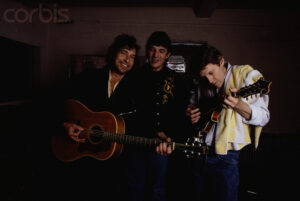
1983, Mahattan, New York, New York, USA — Bob Dylan — Image by © Lynn Goldsmith/CORBIS1983 — Bob Dylan, Levon Helm, and Rick Danko — Image by © Lynn Goldsmith/CORBIS 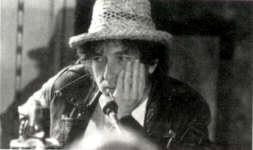
We are left stranded in the state of confusion that Dylan himself experienced when, after a period of apparent spiritual clarity, he was thrown back into a world in which questions of morality and sin could not be so easily categorised. The biting cynicism of the song conveys considerable personal pain. It may be that the eulogy being presented is actually for the Dylan of Slow Train Coming and Saved and that the great anger that the song conveys comes out of the heartbreaking realisation that ‘there ain’t no going back’ to the blissful state of spiritual certainty he had, all too briefly, glimpsed.
LINKS
STILL ON THE ROAD – ALL DYLAN’S GIGS
THE CAMBRIDGE BOB DYLAN SOCIETY
Leave a Reply